Major broadcasters, streamers, producers and creatives descend on Cologne this week for SerienCamp (June 9-11), arriving at a moment when the foundations of TV drama are shifting under everyone’s feet. Commissioning budgets are shrinking, audiences are scattered across social platforms and games, and the cultural weight that prestige television once carried automatically now has to be earned — often with less money than before. From microdramas to AI, IP universe-building and new financing models, here are five issues that will be on everyone’s mind this year.
1. Surviving the Post-Commissioning World
For decades, the logic was simple: producers pitch to broadcasters, broadcasters commission and fund, and the marketing and distribution problem belongs to the channel. That model is now structurally inadequate for the ambitions — and economics — of high-end drama. Commissioning budgets have contracted, the window between greenlight and audience discovery has narrowed, and the channels that once guaranteed cultural reach can no longer deliver it reliably.
“I don’t think quality overall has declined. There are still a lot of great shows out there,” says SerienCamp artistic director Gerhard Maier. “I just think that for those that exist, it’s becoming much harder to find their audience. The cultural impact [of social media or games] is often much higher than that of high-end drama series.”
The producers who will survive the next five years will not be those waiting for the next commissioning round, he argues, but the ones who can build direct relationships with audiences — by owning distribution, treating IP as a long-term asset rather than a one-time license, and developing the B2C capabilities that the traditional B2B model never required them to have. “Think about what your business model could look like if commissioning no longer exists, or no longer plays a major role,” Maier says. “How can you pivot from a B2B business model to a B2C business model?” The question SerienCamp is putting on the table is not whether this shift is coming, but how far European production infrastructure — with its deep dependency on producer-broadcaster relationships — is capable of making it.
2. The Microdrama Moment — What the Creator Economy Can Teach TV
SerienCamp was ahead of the vertical content curve – the conference held its first talks on Microdramas back in 2018, inviting execs from China and Snapchat Originals to present this then-radical cell-phone-first format. Beyond the hype, vertical drama has demonstrated a new means of production — working quickly, often with small teams of just 2-3 creators, using data and audience response to drive creative decisions — that traditional TV has been slow to adopt. Instead of seeing Microdramas as a threat, Maier thinks producers can learn from the lessons of the creator class.
“I think it would be helpful for television producers to adapt to what successful creators do when distributing via TikTok and Instagram, how they test what works on the platform and refine it to rise up in the algorithm to reaching the largest possible audience,” he says.
Online creators can also give pointers on storytelling, “how to generate emotionally complete content in one minute that some series don’t achieve in twenty,” Maier notes.
3. Series as Brands: How To Build an IP Universe
One of the more ambitious conversations SerienCamp 2026 is likely to host concerns a model that has proved enormously lucrative in Asia and the anglophone market, but remains largely theoretical in European TV: the 360-degree IP universe. The idea — building story worlds with multiple touchpoints across series, games, social content and live experience, rather than simply adapting one property across formats — has have long been standard practice in Japan and Korea. “But for me the question is how far the system in Europe, and especially in Germany, even permits something like that to emerge — through the commissioning system, through the relationship between production, creatives and broadcasters,” says Maier.
Structural experiments are beginning to appear. Studio 112 in France is combining the activities of a talent agency with production to package projects before approaching a commissioner, giving creatives a skin in the game and more control over their own content. In Munich, Alan Greenspan, longtime ICM packaging agent and partner at UK production company 6 Degree Media producer (Fever Pitch) has joined forces with investment attorney Tom De Gols to launch Bridge MP, a British/German management and production firm that will actively take stakes in the productions it packages.
“These are examples of companies attempting to practice a form of vertical or diagonal integration a little more strongly,” Maier says.
4. AI As Promise and Existential Threat
The European film and series industry has largely responded to AI as a set of production tools to be evaluated for cost efficiency, an approach, according to Maier, that misreads the technology’s potential for disruption. “I’m often surprised by how relaxed many parts of the film and series industry are — because if you don’t adapt to this, I think it can be existentially threatening,” he says.
While much of the media focus has been on AI replacing individual writers or directors, Maier sees a more structural threat in AI-enabled production at industrial scale generating volumes of “good enough” content that crowds out culturally ambitious work across every distribution channel. In China, AI-driven pipelines are already operational and the displacement, particularly in vertical production, is measurable.
SerienCamp’s dedicated AI conference, Plot Next, will focus on concrete hybrid production models already in use and on practical frameworks for integrating AI into high-end workflows without ceding the creative and cultural ground that differentiates prestige drama from algorithmic slop.
At the moment, there is a strong audience backlash to AI-generated content. “But that is largely driven by the fact that people can identify this content as AI,” warns Maier. “What happens when you can no longer tell?”
5. Works in Progress — the Next Gen of Must-See TV
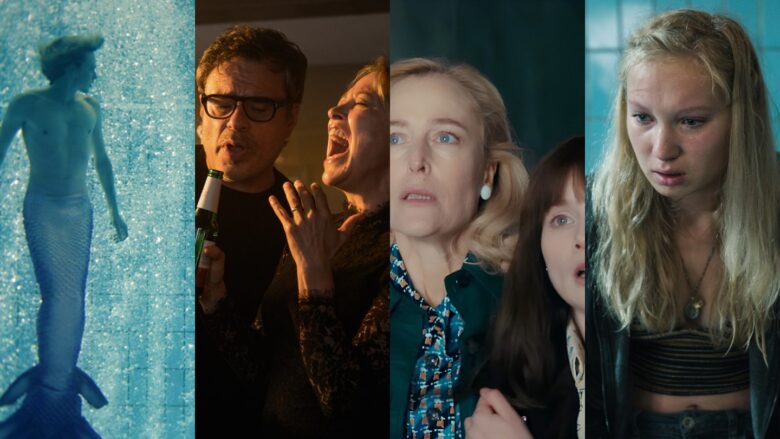
Amid all the discussions of disruption and data-driven innovation, SerienCamp remains a TV drama showcase, a location for best-in-class series from around the world. It’s Works in Progress strand has an impressive track record of discovering the German-language series that will break through globally. Shows like Babylon Berlin, Charité, 4 Blocks, and Maxon Hall all passed through the WIP program before their premieres. “We like to follow a show across its full development arc, from a Writers’ Vision pitch to international co-production financing in the Story Exchange market, to first industry presentation in Works in Progress, to the premiere at the festival,” says Maier. Among the titles to watch at this year’s WIP showcase are Isabel Kleefeld’s upcoming Netflix thriller The Trap and the dystopian new-future drama Dronenland from ZDF/Magenta TV.