When humanity succumbs to the evils of technology, Charlie Brooker will likely be able to point out the exact episode of “Black Mirror” where he predicted it. Since 2011, the show has been painting dystopian images of inventions that have taken over in some form or way, creating custom hells for people stuck living in these worlds. Over time, “Black Mirror” has established itself as one of the best sci-fi anthology TV shows in history, and kept viewers on its toes with a string of great episodes that always seem to be far too close to our own reality for comfort.
In all fairness, “Black Mirror” hasn’t always delivered. As tends to be the case with anthology shows, there have been a fair few strikeouts over the years, but that’s only to be expected. After all, even “The Twilight Zone” has its worst episodes. However, when “Black Mirror” is good, it’s really, really good. These are the 15 absolute best episodes of this seminal sci-fi series.
15. White Bear (Season 2, Episode 2)

Written by Charlie Brooker and directed by Carl Tibbetts, “White Bear” is an atypical “Black Mirror” tale with a tone that would be right at home on any “The Twilight Zone” revival. The sophomore episode of “Black Mirror” Season 2 is almost a horror story — it just holds its villain reveal very close to its chest until late in the game.
“White Bear” unfolds through the eyes of Victoria (Lenora Crichlow), a young woman who wakes up in a mysterious location with no memory of how she got there. TV screens display a strange symbol that has apparently turned almost everyone in the world into unsympathetic voyeurs. For a good while, it seems that “Black Mirror” is simply playing with the concept of bystander effect and the zombifying effects of screen time — and then, one of the bigger twists in the show’s history arrives.
As it turns out, the episode’s quasi-postapocalyptic setting is actually a massive amusement park where visitors watch Victoria relive the same horrifying day over and over as punishment for a terrible crime. We’ve been watching an allegory of violent deeds being turned into a public spectacle where society gleefully crucifies the culprit over and over again. The fact that Victoria committed a genuinely irredeemable crime adds layers to the situation, but her constant, amnesiac suffering as the bloodthirsty public looks on is exactly the kind of thought-provoking storytelling “Black Mirror” excels at.
14. Black Mirror: Bandersnatch (Interactive film)
In 2018, “Black Mirror” dropped its strangest and most ambitious concept yet with “Black Mirror: Bandersnatch.” Directed by David Slade, the interactive film sees Charlie Brooker’s storytelling at its twistiest, courtesy of the several narrative choices that the viewer has to navigate.
Set in 1984, “Bandersnatch” is an interactive film about an interactive game that the increasingly concerned and disturbed programmer Stefan Butler (Fionn Whitehead) is adapting from an interactive adventure book. Before long, the nature of the narrative and his monumental task begin affecting Stefan, who starts seeing the forks in the road, just as Jerome F. Davies (Jeff Minter), the author of the book he’s adapting, once did. Death, mind control, or time travel may or may not occur. Depending on the choices the viewer makes, the poor programmer may even get a peek through the fourth wall and discover that he’s simply a character in an ambitious Netflix story.
Without doubt the most technically ambitious “Black Mirror” installment, the central themes of “Bandersnatch” are control and surveillance. Granted, not every one of its storylines is a winner. Still, there’s a lot for viewers to play with, and one particular ending, which reveals that Colin (Will Poulter) and Kitty’s (Tallulah Haddon) daughter (Laura Evelyn) suffers a similar multiple-choice collapse while making the Netflix version of “Bandersnatch,” is vintage “Black Mirror.”
13. Beyond the Sea (Season 6, Episode 3)
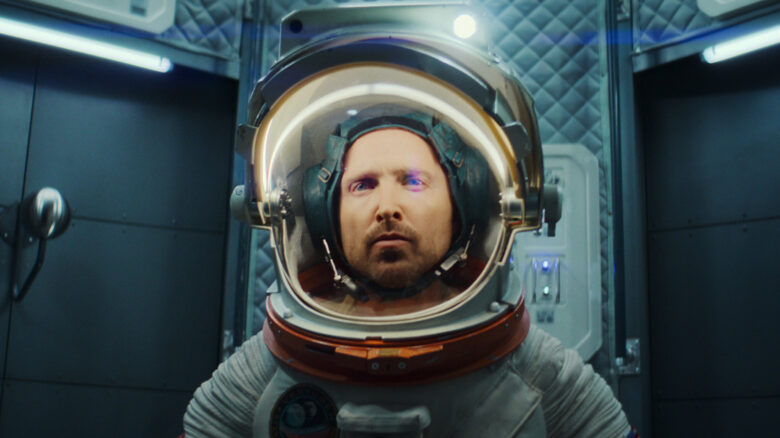
Despite strong performances from Josh Hartnett, Kate Mara, Auden Thornton, and Rory Culkin, the John Crowley-directed Season 6 standout “Under the Sea” is ultimately Aaron Paul’s show. Paul plays a dual role as astronaut Cliff Stanfield and an artificial body on Earth that he can transfer his mind into during his spare time, which allows him to be with his wife Lana (Mara) and son Henry (Daniel Bell). When Cliff’s mission partner David (Hartnett) loses his own artificial body and family in a cult attack, Cliff reluctantly lets the grief-stricken astronaut borrow his artificial body so he can spend limited time on Earth. However, trouble begins brewing when David starts to connect with Lana during his borrowed time in Cliff’s body.
From a technological standpoint, “Beyond the Sea” explores how tech can be used to connect in remote relationships. However, that’s not really the point of “Beyond the Sea.” The story it really tells is one of loss, loneliness, and deeply toxic masculinity, all filtered through a retrofuturistic 1969 setting and culminating in one of the most brutal endings in the show’s history.
12. Playtest (Season 3, Episode 2)
Leave it to “Black Mirror” to twist the concept of game testing to the extreme with the Season 3 episode “Playtest,” where Wyatt Russell’s Cooper Redfield gets more than he bargained for when he signs up for such a gig. Unfortunately for him, the game he’s testing is a cutting-edge augmented reality horror game — and almost instantly, it’s clear that something has gone horribly wrong.
By this point, “Black Mirror” viewers know to expect as much. However, Dan Trachtenberg’s direction keeps the psychological horror themes of the episode front and center. Rather than relying on jump scares alone, the episode builds dread by making both Cooper and the audience question what’s real. As “Playtest” slowly unfolds through increasingly unsettling inconsistencies and horrific sights, the key question isn’t what’s happening, but how far the rabbit hole goes. Suffice it to say, it’s worth paying attention to every decision Cooper makes leading up to the fateful test.
11. Be Right Back (Season 2, Episode 1)
Season 2 opener “Be Right Back” explores the concept of artificial human beings. In this case, the copies in question are hollow shells filled with the digital footprints of people who have passed away. What we say about ourselves online might be enough to create a serviceable AI replicant in the eyes of a passing acquaintance, but is it really as good as the real thing? “Be Right Back” argues that it isn’t.
After the shocking death of her boyfriend, Ash (Domhnall Gleeson), shortly after they move in together, Martha Powell (Hayley Atwell) discovers she’s pregnant and begins using an online service that allows her to chat with a virtual copy of Ash. Eventually, she upgrades to an android that’s physically similar to Ash, but soon realizes that a construct built from one person’s online behavior doesn’t make for a fully realized human being.
There’s no traditional horror involved in this particular story, beyond the existential one that stems from grief and loss. The tension comes from Atwell’s portrayal of Martha’s deep sadness and loneliness as she tries and eventually fails to fill the void in her life with an artificial echo of a human being.
10. Joan Is Awful (Season 6, Episode 1)
“Joan Is Awful” is a rare unabashedly comedic “Black Mirror” episode. It revolves around Joan Tait (Annie Murphy), a regular woman who discovers a dramatized version of her life streaming on a fictional Netflix parody, with a virtual actor based on Salma Hayek playing her. As Joan learns to disrupt the program with her own unhinged actions, she and the aggrieved real Salma Hayek team up to stop the network. However, we eventually learn that the quantum-computing rabbit hole behind the show goes even deeper than Joan ever imagined.
An evisceration of profit-driven streaming network behavior and digital likeness rights in the age of AI, the Ally Pankiw-directed episode combines cringe comedy with a sharp critique of predatory, creatively bankrupt entertainment companies. Combine all this with a fun “The Twilight Zone”-style plot twist in the end, and “Joan Is Awful” is nothing short of a great time. It’s one of the few episodes that proves “Black Mirror” can be just as effective when it’s making viewers laugh as when it’s leaving them unsettled.
9. Demon 79 (Season 6, Episode 5)
TVLine’s pick for the best “Black Mirror” Season 6 episode when it premiered, “Demon 79” has a wild premise even by the show’s standards. The year is 1979, and Nida Huq (Anjana Vasan) is thoroughly fed up with the racist attitudes of Britain at the time. She accidentally releases a demon called Gaap (Paapa Essiedu), who demands three ritual sacrifices lest the world end on May Day. Oh, and Gaap also looks like the Boney M. singer Bobby Farrell.
Directed by Toby Haynes and co-written by Charlie Brooker and Bisha K. Ali, “Demon 79” is devoid of the show’s usual tech-heavy approach. Instead, it fully commits to telling a darkly comedic story about a woman who suddenly has the opportunity to strike back at the people who have oppressed her. This being “Black Mirror,” things don’t go quite the way Nida, Gaap, or even the viewer might assume. Still, the episode’s tonal departure pairs well with its social commentary, and both Essiedu and Vasan are great across the board.
8. The Entire History of You (Season 1, Episode 3)
A rarity because Charlie Brooker wasn’t involved in its writing, director Brian Walsh and writer Jesse Armstrong’s “The Entire History of You” is a tragic tale of using modern technology to invade other people’s privacy. The episode’s central piece of technology is the grain, an implant behind the ear that turns a person’s eyes and ears into recording devices. The data stored in these implants becomes the catalyst for the downfall of Liam (Toby Kebbell) and Ffion Foxwell (Jodie Whittaker). Over the course of the episode, their marriage succumbs to mistrust in a stark marital drama that shows how full access to the exact memories of things that were said and done in the past can escalate a relationship conflict.
Liam’s jealousy and obsession with grain footage serve as our way into this world of constant surveillance. Yet, “The Entire History of You” carefully builds an entire world shaped by this technology around its central story, wrapping an unnervingly recognizable sci-fi setting around an intensely human tragedy.
7. Nosedive (Season 3, Episode 1)
Perhaps the most topical and on-the-nose “Black Mirror” episode, which is saying something. Yet, “Nosedive” manages to get its message about the futility of online ratings and social media approval across because its delivery is very, very good. That has a lot to do with the episode’s comedic tone, which stems in part from Charlie Brooker’s story receiving a teleplay by Rashida Jones and “Parks and Recreation” and “The Good Place” creator Michael Schur.
Bryce Dallas Howard shines as Lacie, a woman who strives for a better life in a world where success and opportunities are directly dictated by a person’s online ratings. You can probably guess how well that works out for her, but Lacie’s mishap-filled mission to improve her rating at her popular friend Naomi’s (Alice Eve) wedding is a perfect example of the journey being more important than the destination. While what Lacie thought was her whole world crumbles piece by piece, “Nosedive” challenges the viewer to ask themselves how important social media truly is — and then answers the question itself in a hilarious, conclusive fashion.
6. White Christmas (Holiday special)
“White Christmas” is an atypical holiday special, as well as a particularly twisted “Black Mirror” episode that inspired Apple TV’s “Severance.” It’s definitely one of the cruelest tales that the series has ever given us, turning the concept of digitizing people’s consciousness into a nightmarish vision of hell.
A mini anthology in its own right, “White Christmas” consists of three interconnected stories that two men living in an isolated cabin tell each other. First, Matt (Jon Hamm) tells Joe about a community-guided pickup artist (Rasmus Hardiker) who attempts to seduce the wrong woman (Natalia Tena), before recounting his own history working with digital “cookie” copies of people that are enslaved as personal assistants. Joe (Rafe Spall) responds with a story that discusses the technology to use social media-style “blocks” on real-life people, with a predictably tragic end. Finally, the stories intertwine as “White Christmas” reveals what’s really been happening all along, showing just how horrifying the episode’s technologies can become. Happy holidays, viewer!
5. The National Anthem (Season 1, Episode 1)
Say what you want about “The National Anthem,” there’s no denying that the “Black Mirror” Season 1 premiere was the kind of opener that grabbed people’s attention. Rory Kinnear runs the full emotional gamut as U.K. Prime Minister Michael Callow, who faces an impossible situation: Princess Susannah (Lydia Wilson) has been kidnapped, and the very public ransom demand is that he have televised intercourse with a pig.
Directed by Otto Bathurst, much of the episode runs like a fairly conventional thriller, albeit with extremely unconventional stakes. However, Charlie Brooker’s story changes its mood sharply when it becomes evident that Callow will indeed have to comply with the demands — and when the viewer realizes for the first time that “Black Mirror” is a show that’s fully willing to go that far. The eventual reveal that this was all the final work of an award-winning artist is a perfect cherry on top.
“The National Anthem” tinkers with internet outrage, deepfakes, and other technological themes. However, it’s not one of the show’s more straightforward “here’s where this particular technology could lead us” morality tales, which can arguably become a bit repetitive over time. Instead, the series premiere is a sweeping reflection on media, art, politics, and the value of personal morals when they clash with the needs and demands of the public.
4. Hang the DJ (Season 4, Episode 4)
“Black Mirror” doesn’t always tell love stories, but when it does, it has been known to produce absolute gems. More importantly, it proves the series doesn’t have to end in despair to leave a lasting impression. The Season 4 date app tale “Hang the DJ” is one of the best examples of this. Throughout the Tim Van Patten-directed episode, we follow Frank (Joe Cole) and Amy (Georgina Campbell), two people navigating their love lives under the guidance of a dating system that pairs couples together for varying lengths of time before determining their supposedly perfect match.
If this sounds like an imperfect system, Frank and Amy quickly learn to agree. They navigate their own personal romance amidst the machine’s whims over the course of time, ultimately questioning the entire concept. Still, while the horrors of online dating are perfect fodder for a show like “Black Mirror,” the episode refuses to take the easy route and go dark. When “Hang the DJ” reveals its final twist, it’s a surprisingly heartwarming one.
3. USS Callister (Season 4, Episode 1)
“USS Callister” resonated strongly enough to earn a Season 7 sequel in “USS Callister: Into Infinity,” but the original reigns supreme. Te concept of virtual reality game company CTO Robert Daly (Jesse Plemons) stealing his coworkers’ DNA and trapping their digital copies in a “Star Trek” expy of his own private power fantasy is riveting enough, but the casting is the true king here. Who else but Plemons could infuse Daly with the embittered man-child energy the role requires? And who better than future “The Penguin” standout Cristin Milioti to counteract Daly’s toxicity as Nanette Cole?
The episode truly excels when the digital clones start planning an escape and the digital and reality storylines intertwine, which makes “USS Callister” more than just a riff on the classic “The Twilight Zone” episode “It’s a Good Life.” A great cast, Toby Haynes’ direction, and a story by William Bridges and Charlie Brooker make this comedic sci-fi caper one of the most unabashedly entertaining “Black Mirror” episodes ever made.
2. Fifteen Million Merits (Season 1, Episode 2)
“Fifteen Million Merits” condenses the grind of modern existence down to its bare essentials. In its world, people earn merits through physical labor, while screen time serves as both a welcome escape and an inescapable prison. Here, Bing Madsen (Daniel Kaluuya) finds a brief distraction from the daily toil in Abi Khan (Jessica Brown Findlay), whom he sponsors into a talent competition to give her a better life. Of course, a “Black Mirror” version of a talent show is even crueler than the real thing, and this Orwellian world of control and force-fed entertainment demonstrates that success is hardly better than failure for those trapped within it.
Directed by Euros Lyn and written by Charlie Brooker and Konnie Huq, “Fifteen Million Merits” is the first “Black Mirror” episode that fully embraces the dystopian tech themes that went on to become the show’s defining feature. In doing so, it set the bar very, very high.
1. San Junipero (Season 3, Episode 4)
“San Junipero” elicits emotion, but not dread. Even the technology it depicts is ultimately benevolent. The digital great beyond of the titular community is essentially a peaceful online multiplayer world where people’s ideal selves can interact regardless of their offline circumstances. This is more than enough to make it the single greatest episode of “Black Mirror.”
This unexpected barrage of Season 3 positivity plays out like a slow-burn love story between Kelly (Gugu Mbatha-Raw) and Yorkie (Mackenzie Davis), an odd couple who meet in a town that eventually turns out to be a simulated afterlife. As the story unfolds, we also learn that neither woman is quite what she appears to be, and their views on San Junipero are diametrically opposed.
Philosophical, sweet, and atypically joyful, Charlie Brooker’s story and Owen Harris’ direction combine with the stellar performances of Mbatha-Raw and Davis to give “San Junipero” a beating heart that no other “Black Mirror” episode has matched before or since. Interestingly, a bleak deleted scene could have changed everything about the episode, but Charlie Brooker wisely chose to leave it out and let “San Junipero” become exactly what it needed to be.