[Editor’s note: The morning after the finale aired, Hébert replied via email to a few follow-up questions.]
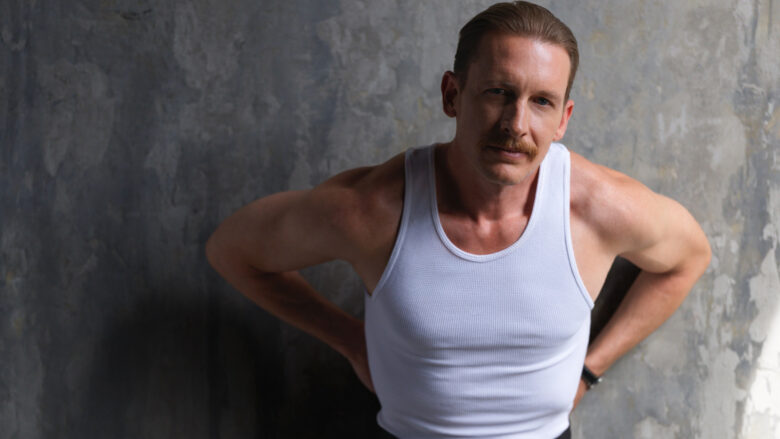
TVLINE | So Harley didn’t die — but he also didn’t go out in a blaze of glory like he seemed to want to. Were you surprised he didn’t put up a fight as the DEA was closing in on the house?
I was surprised at first, because there was a version where Harley did go out in that full, outlaw blaze of glory. But honestly, I think this ending is stronger.
For a guy like Harley, dying loud might’ve been easier. Living with consequences is the harder sentence. He’s spent the season chasing infamy, being feared, respected, remembered, but in that final moment, I think he realizes if he starts shooting, it’s over fast — and then they get to Laurie, Wayne, Bruce, everybody else. So instead of going out guns blazing, he milks the arrest. He buys time for his family to get away.
Asante Blackk, who plays one of Alamo’s guys and who I’m working with on Snowfall, saw it and said Harley’s ending gave him American History X energy, which meant a lot. Not because I’d ever compare myself to Edward Norton, but because that kind of ending is about consequence. It’s about a man being forced to sit inside what he’s done instead of escaping through violence.
It’s still Harley, so I don’t think he suddenly becomes a saint. But for once, he takes responsibility in his own twisted way. He protects his family by living instead of dying for them. And if he survives, that hunger for infamy doesn’t just disappear. He might not be King of the Desert anymore, but he’ll damn sure try to be King of San Quentin.
TVLINE | Did anything else surprise you as you were watching?
Honestly, a lot surprised me. Even when you’re there shooting pieces of it, you don’t really know how it’s all going to land until you see the whole episode put together…
Emotionally, what really got me was the way Sam kept the spirit of Angus Cloud and Fezco alive. The news of Fez breaking out of prison and disappearing was so beautifully handled. It felt like a tribute without being heavy-handed. I was in tears through a lot of the episode, and I’m sure fans were too.
What happens with Rue is devastating, and I think it connects to what Sam has always been exploring with this show: addiction, grief, recovery, relapse, and how fragile that whole cycle is. “Euphoria” doesn’t pull punches. It shows the beauty, the hope, the damage, and the possibility of things going wrong even when you want them to go right. That’s why it hurts so much.
And that Colman Domingo and Alamo face-off — to me, that was one of the most epic scenes I’ve ever seen on television. It felt like a Western, a tragedy, and a reckoning all at once. Colman is just operating on another level.
I was also surprised by how quiet Harley’s ending became. There was a version with the song “I’m a Good Old Rebel” and a much bigger death, and I worked on that song a lot. My horses were probably sick of hearing me sing it. But what ended up onscreen felt more painful in a way — no big glory, no clean exit. Just consequence.