
The following is a conversation between Robert Daniels and Odie Henderson conducted over Zoom about John Singleton’s “Baby Boy,” the third film in his hood trilogy that features Tyrese Gibson as Jody, a young man living in Los Angeles with his mother Juanita (Adrienne-Joi Johnson) as he navigates a sticky relationship with his girlfriend Yvette (Taraji P. Henson), her incarcerated ex-boyfriend Rodney (Snoop Dogg), and with his mother’s new boyfriend Melvin (Ving Rhames). Strap in: We’re riding through South Central to Singleton’s “Baby Boy.” And read previous Robert/Odie conversations about “Wild Wild West,” “Sinners,” and “Highest 2 Lowest” here.
Odie Henderson: I have a question for you: Do you know a Yvette?
Robert Daniels: I know a couple of Yvettes [laughs]. I first saw “Baby Boy” when I was about 11 years old. I grew up on the west side of Chicago. So I went to an all-Black school, which, when I say that to people who aren’t Black, they never believe that’s such a thing as an all-Black school.
Odie: There are. Believe me!
Robert: Mhm. And of course, every so often, we’d get a substitute teacher, and that substitute teacher, usually they’ve just gotten their certificate, and they’re a white person from the north side, would wheel in the TV on the AV stand so we could watch movies. That’s actually the first time I saw Tyler Perry’s play “I Can Do Bad All by Myself.” We’d also watch family-friendly stuff like “Remember the Titans.” But one day, my friend Tyrone brought in “Baby Boy,” and the substitute teacher, who was some Gen-Xer with spiky hair, heard the title and thought it was all right for these kids. Within the first ten minutes of “Baby Boy,” he knew he had made a mistake and left the classroom for plausible deniability.
Odie: Come get me when the credits come! My middle brother, when they had a substitute, they said bring in your videos. My brother brings in “Pretty Woman,” which is far less dirty than “Baby Boy.” But it’s still an R-rated movie. The teacher didn’t know and put it on. My brother got in trouble, and we got sent to the principal’s office. They thought he was doing this intentionally. My brother’s like: Well, if I knew I was gonna trouble, I’d have brought in something that was nastier.
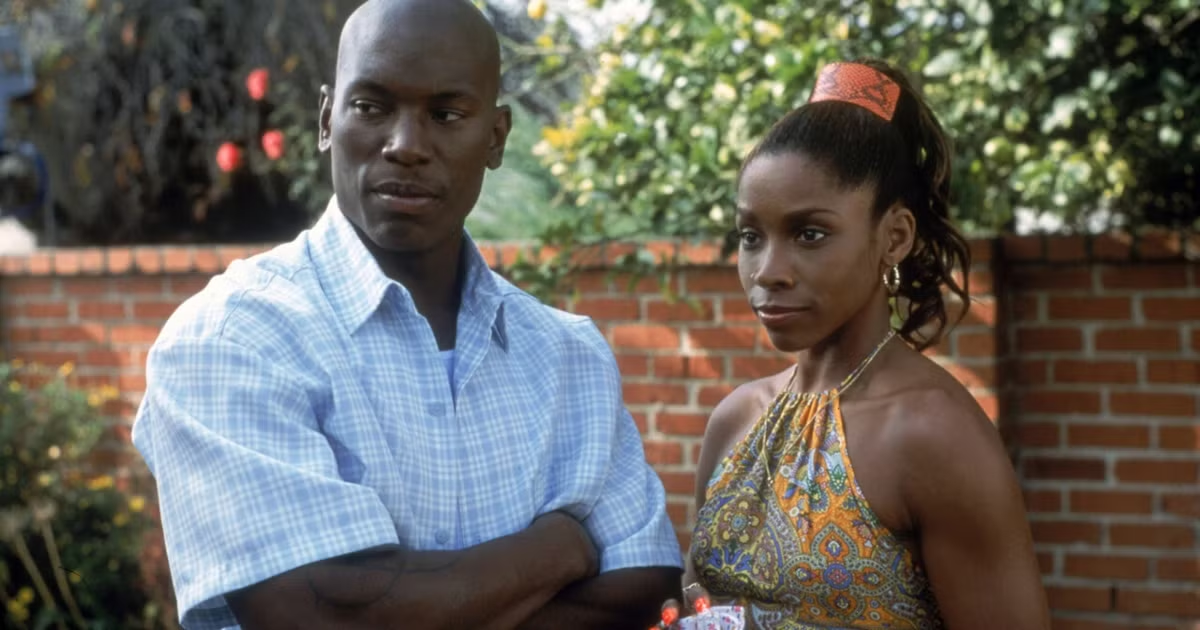
Robert: Well, we went all the way! When “Baby Boy” ended, all the kids looked around the class, pointed at one girl, and said, “You’re Yvette.” Black kids have no shame! She stayed Yvette for the rest of her life.
Odie: Yvette in training! I read too much into so many things, but “Yvette” is my cousin’s middle name. My older cousin’s middle name is Yvette. And LL Cool J had that song, “Dear Yvette.” When you’re Black, and you’re born, and they name you Hezekiah or Ezekiel, you just have to be a preacher. That’s your preordained name. Cleophis ain’t no accountant. He’s a preacher. So, I wonder if Yvette kind of stems from a certain type of around-the-way girl. Her name has gotta be Yvette.
When I saw this movie, I saw it with a bunch of younger heads I hung out with. I was always the youngest person around because I was ahead of myself in school—and then all of a sudden there was a point where suddenly I became the oldest person in the group. I don’t know how in the hell that happened. But I went with a couple of younger guys who were in their 20s, and I was already 31 at this point—and this movie made them so mad because they were Jodys.
It’s also interesting that this is John Singleton’s last movie that he wrote. With this film, he was kind of reading the neighborhood for filth. And it struck a nerve with some of these dudes. One of them was more like Rodney than anything else. But the other two dudes I hung out with were straight-up Jodys. They thought this movie sucked, man.
Robert: Funnily enough, my friend Tyrone was a Jody. But he loved this movie. I think he thought it was a documentary.
Odie: This was supposed to be Tupac’s movie. But then Tupac got killed. That’s why there’s that great little mural of him on the wall of Jody’s room. I think Tupac would’ve bought a different flavor for this movie. He would’ve been a little bit more like his character in “Poetic Justice.” In this, he would’ve acted opposite Iesha rather than Justice, because Regina King’s Iesha is kind of the origin of Yvette. But the “Baby Boy” version is from a more mature writer, which shows growth in Singleton’s writing because he tends to have a problem writing women.
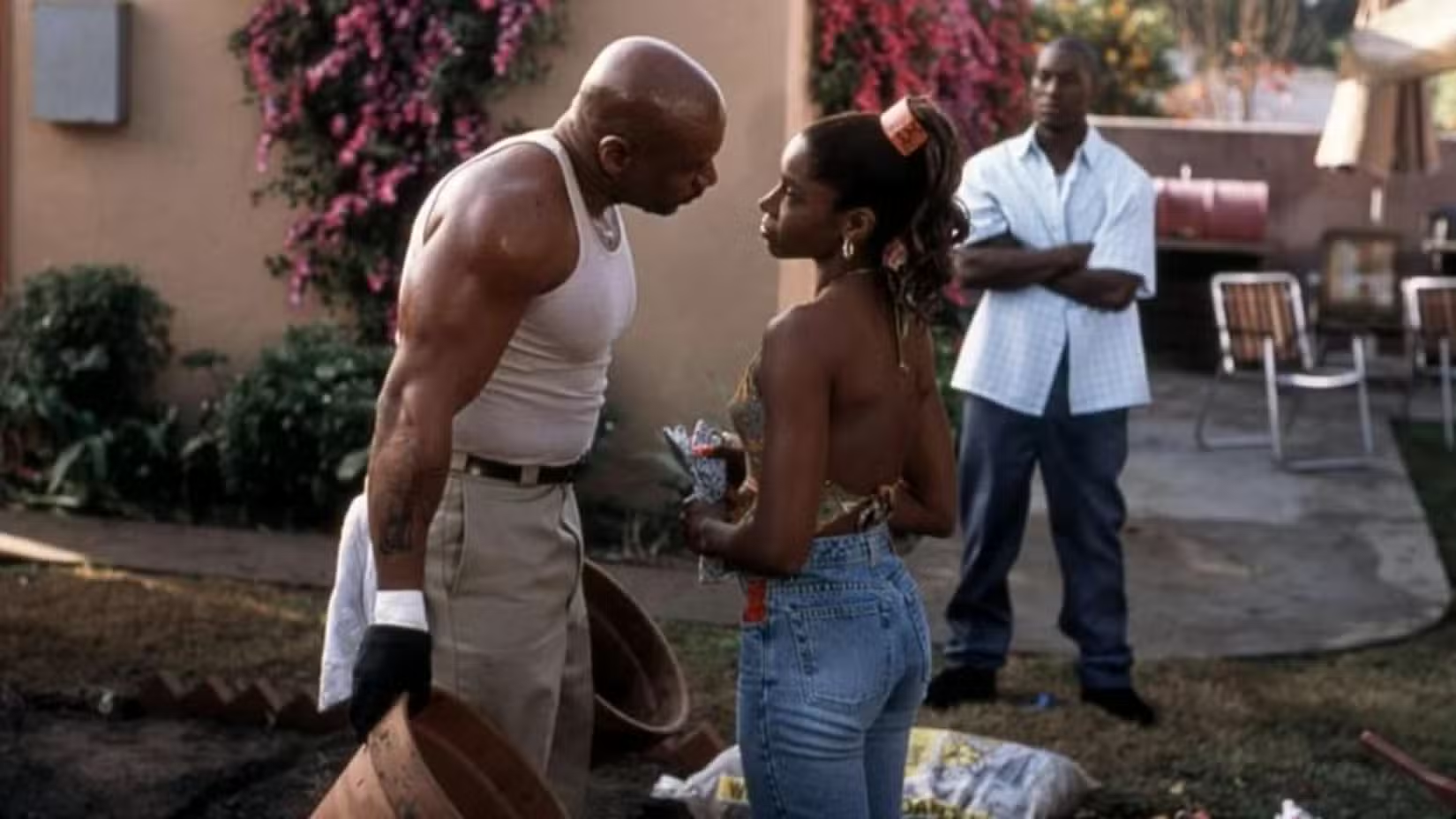
Robert: I think this is some of his best writing of Black women. One of my big critiques of “Boyz n the Hood,” for instance, is how one-note all the Black women are. They exist only as mothers, lovers, and caregivers to Black men. That’s it. They don’t have any kind of world outside of that. That’s one of the ways Coogler is a modern Singleton: Black women fulfill those basic roles. Coogler also casts phenomenal actresses who can pull stuff out that might not necessarily be on the page. Still, I think Coogler is generally better than Singleton was at writing Black women.
Odie: He’s much better than Singleton! You can make the same argument, and I’m going to get struck by lightning here in a second, for Tyler Perry. Why do you think these great actresses, Cicely Tyson, Taraji, and even Janet Jackson, to a lesser extent, are busting their behinds for Tyler Perry screenplays? They’re bringing more to it than I guarantee you is on the page. But at the same time, why do y’all keep working for him? You’re gonna get this crappy script where you basically have to work overtime to get the depth you want. But I’m wondering if in his case, these actresses have done this for so long, making more out of less, that it’s almost second nature. No matter how hollow the role is, they’re gonna bring something to it.
Robert: Taraji P Henson, though, has such a meaty role in “Baby Boy.” And “Baby Boy” is also interesting because you see Taraji and Tyrese, these actors who become Singleton’s collaborators for basically the rest of his career. This is kind of the best that all of them are in his movies, particularly Taraji P Henson, who’s probably in her best role, which is saying something because there’s “Hustle and Flow” and “Hidden Figures.” And while the character is so fully written, in a lesser actress’s hands, Yvette would not be iconic. Yvette would just be a joke. But in Taraji’s hands, she’s given this realism and depth.
Odie: And this is an early role for her. It’s early in her career, and she’s already got the attitude. While watching this, I thought about her performance in Don Cheadle’s movie “Talk to Me.”
Her character in that movie is kind of like a big comedic stereotype for three-quarters of the movie. And then she has that one scene where she completely drops this facade, and all of a sudden, you really see what she’s doing and what her character is up to. It’s this gorgeous little piece of acting on her part. I think this movie has sequences like that, where she has moments of clarity and gravity about the situation. You can see her mind working: I know that Jody is no good for me. We got a kid. He’s cheating on me. In lesser hands, she’d just be a doormat, and you would not feel for her. You would be like, “Girl, get rid of him.”
But let’s talk about the other woman in this movie. Jody’s mom, Juanita. You can draw a line from Angela Bassett’s Riva in “Boyz n the Hood” to this character, who is obviously a lot more fleshed out because she has more screen time. She is the opposite of the big criticism of “Boyz n the Hood.” In some people’s minds, that movie was saying that Angela Bassett couldn’t raise a boy.
And so, with Juanita raising Jody and he’s still at home, I think people could say, well, the mother’s forcing him to stay at home. But she’s got a life. A lot of times in these movies, the mother’s supposed to just give up her life to take care of some badass kids, and you forget that she was a person and that she existed. But this movie does not have it at all. She wants to get her back blown out and to tend to her garden.
And so what I think Singleton intentionally does is that he doesn’t give her the lawyer on “The Boondocks.” That’s not what she got. She got a pimp named Slickback. Ving Rhames’ entire performance, up until the big scene where he has the gun and he kind of silently says, “I understand,” which almost makes me think of the scene in “Cooley High” between Ivan Dixon and Bill Duke where these two men come together, and Ivan Dixon as the elder statesman who went to jail is trying to stop the other person from doing it. But before that, Ving Rhames’ entire role is to emasculate Jody.

Robert: Every time I watch a Ving Rhames film, it makes me hate the day when he got really good at saying “Ethan.” He was once fantastic.
Odie: I will always love him for “Don King: Only in America,” which is one of the greatest movies I’ve ever seen. I will die on that hill. I think it’s one of the greatest performances I’ve ever seen given by anybody. But he’s also great in “Holiday Heart,” which is a completely different kind of role. He’s amazing in “Rosewood.” He is so versatile, which isn’t common for a big man. Especially not a big Black man or a big man of color. He’s not afraid to go places where another director, with an actor who looks like him, wouldn’t go at all.
Robert: A lot of actors with his kind of build will have their serious kind of crime roles, and then if they do something out of those confines, it’s strictly comedic. It’s something where they use their body as a kind of joke or as a pratfall. Outside of “Dave,” Ving Rhames never really did the latter. He had a string of eclectic roles through the 1990s up until “Dawn of the Dead.” And as you alluded to, in this movie, he was once Baby Boy. He was Baby Boy, and then his life fell apart, and he’s still trying to put it back together. He’s just now getting to the point of Zen.
Odie: To your point about Ving Rhames’ character being older and finally kind of realizing that he wasted his life with so much stuff, my late uncle Sterling would try to talk to me. And he’d say, and I say this to my niece and nephews all the time: You’re a hardheaded teenager. You don’t wanna listen to this nonsense. But one day, you’re gonna remember that we had this conversation. As I got older, it would click when I realized what he was telling me was right. One day, before he died, I went to him and asked him, “Unc, do you remember he used to tell me one day I’d remember we had this conversation?” He said: Which one?
Robert: Quick change of subject. I have to ask you: Who was the booster in your neighborhood?
Odie: There were a couple of people in my neighborhood, and there was one person on my grandmother’s block. My grandmother’s house was the meeting place for us. My cousins who were my age were there, and some of my aunties lived there at the time–they were adults. On Bergen Avenue in Jersey City, where my grandmother’s house was and still is, there are some bad blocks. Lexington Avenue was one of the more famous bad blocks. If you went down there or down on Clinton, you could find people who sold anything. In fact, when I wanted to get my Run DMC outfit, my mother said, “If you want some Run DMC clothes, you need to get yourself a Run DMC job.” So, I got two paper routes. I couldn’t even ride a bike back then. I was running from dogs on foot, and I made enough money to buy the jeans and the jacket from Delancey Street, but I got the sneakers from one of the boosters. I also remember one year we got a Nintendo from one of the boosters.
But I forgot that was a detail in the movie. Jody sold dresses out of his trunk. He’s good. There were several people in my old neighborhood who, depending on what you wanted, you went to them. It was like a network.
Robert: In my neighborhood, we had the sock man. White and black crew cut socks wrapped in rubber bands. He also had a scent business, and during Christmas, he sold toys. Once a year, my dad would give me $5 to go find the sock man because he needed more socks. He also got a lumberjack jacket from the sock man. And then, of course, at the currency exchange, there was the bootleg DVD man. Singleton’s cameo here is as the bootleg DVD man.
Odie: He was also the postman in “Boyz n the Hood.”
Robert: A month ago, I ranked Singleton’s movies for Vulture, and I nearly ranked them by his cameos.
We also have to talk about Snoop as Rodney. Rodney might be the most complex character of Singleton’s career in the sense that he is a terrible person—the first time we see him out of prison, he tries to rape Taraji—and in every interaction he has with Jody’s kid, he is the literal definition of ‘fuck them kids’. But Singleton doesn’t keep Rodney as the big bad. He’s clearly a foil to Jody in the same way Ving Rhames is. He’s a vision of what could happen to Jody if he doesn’t get his life straight. Snoop, consequently, plays him with surprising groundedness. And to my mind, the movie doesn’t get churning until he gets out of prison.
Odie: It’s funny because I’m thinking of another Rodney. This is Rodney, much more dangerous than Delroy Lindo’s character in “Clockers.” His name is Rodney, too. I wrote about the depths of immaturity that Delroy Lindo goes to in that role when he gets mad. He seems to be an adult until the moment he goes off. There’s that scene with Mekhi Phifer, where he’s in the car and he pulls Mekhi Phifer down into his lap and puts the gun in Mekhi’s mouth. Like, if you shoot him, you’re gonna hurt yourself too. But he’s so angry. He’s an 8-year-old kid having a tantrum.
Snoop Dogg’s Rodney is exactly that. He can be civil until the second he feels that he’s been dissed or disrespected. The idiocy of his character is what drives him to try to shoot Jody. It leads to his demise. He’s being stupid, and he’s being exactly what Ving Rhames’ character, Melvin, says to Jody. So I can see what you mean about Rodney being the most complex character. He’s the catalyst. He’s the linchpin in Jody’s maturity.
Robert: Rodney is the one who heightens everything to a Sirkian level.
Odie: Right? “Jungle Fever” is also Spike Lee’s Douglas Sirk movie. It’s his 1950s movie. It’s half “Marty,” half “Imitation of Life” because of Samuel L Jackson’s character. Everything else going on is kind of filler, and then when he shows up and he goes to the Taj Mahal, still the most phantasmagorical crack house I’ve ever seen in my life, the movie becomes about Gator. It’s the same kind of turn here. Rodney appears, and it centers on him.
What separates this movie from “Boyz n the Hood,” which I identify with a lot because of where I grew up, is that I think this movie widens the net on the Black experience. Because “Boyz” is set in such a contained environment, and even though the emotions are more universal, the reference points that you get here don’t need any explanation. You know a Yvette. The characters, their situations, and their interrelationships have a slightly more universal “Blackness” than in “Poetic Justice” or “Boyz.” And when you talk about influences that he used, this is his Sirk movie. “Poetic Justice” is his Éric Rohmer movie. When I did the tribute to Singleton at the site, I said that it meandered like Éric Rohmer and swore like Richard Pryor.
Robert: Other than “Love Jones,” “Baby Boy” might be the only film that’s gone from heavy rotation on BET to being in Criterion. And I don’t use BET pejoratively. “Baby Boy” has a massive audience. Only in the last 15 to 20 years has mainstream film criticism, for instance, really caught up to the fact that the lowest-tier Blaxploitation film says so much about its era and the people who lived through it. You could say the same thing about the populist Black movies of the 1990s and the early aughts. They say a lot about the period. The “Best Man” series says so much about the morals, beliefs, and aspirations of Black life. The same with “The Inkwell” and “The Wood.” Those movies say more than anything you’ll find at any distinguished film festival. And to your point, “Baby Boy” does the same thing.
Odie: His films after “Boyz” are also messier. They’re more ambitious. “Higher Learning” is ambitious, but to its detriment. “Poetic Justice” is one of his most ambitious, in my mind, because it’s so unlike what you would expect a movie with a bunch of Black people in it to be like. It takes its time. It doesn’t really have a purpose or a sense of where it’s going. It’s a kind of foreign film. People are sitting around talking about life in a mail truck. “Poetic Justice” and “Baby Boy” are his most ambitious. After that, he stopped, and I don’t know why, but he stopped really telling his stories or writing his screenplays. All of a sudden, he became a director for hire.
Robert: “Baby Boy” came out right at the tail end of that new Black film wave. At that point, Spike would make “Bamboozled” around that same time, but many of Singleton’s ’90s contemporaries were trying to figure things out. If you were part of that generation, you had to wait until the resurgence of the 2010s, which is when Spike began his comeback. I think what happened with Singleton was that he probably did have original stories he wanted to tell, but the cycle of getting budgets for those stories was over. And so he started seeking out studio work, gun for hire things that still kind of had his sensibility in the heart of the idea, like “2 Fast 2 Furious,” which is still very much a Singleton movie.
Odie: Final thoughts on “Baby Boy”?
Robert: I’m glad we got to talk about “Baby Boy.” I think you can tell in these conversations that I’m interested in Black cinema from the 1990s and the early aughts, and in what they say about Black life and the specificity they show. But these films have mostly been kind of relegated to low, crass art. But in actuality, “Baby Boy” is probably the high art of his career. It just so happens that there are these very specific references to a neighborhood whose story isn’t following the agreed-upon narrative conventions that something like “Boyz n the Hood” is following.
Odie: It’s been a while since I’d seen “Baby Boy,” and I realized while watching it again that it immediately brought me back to when this movie came out. It came out on June 27th, which is a Wednesday, because it was a Black movie. And I saw it literally a 10-minute walk from where I am right now at the Newport Mall. I went to see it there.
Watching it took me back to everybody I knew who was like a character in this movie. I remembered friends that I’ve lost and friends that I still have. The Yvettes stuck out for me. I just had so many memories of my cousin, the girl my cousin was messing with—together they were Jody and Yvette. It made me really sit here. I wasn’t watching a movie anymore.
And so it struck me how ingrained this movie became in me over the years, and how closely it related to my life. I think a lot of Black people feel the same way. So at the end of the day, I mean, I started thinking about, well, maybe I was wrong to have “Boyz n the Hood” as my number one Singleton movie.
Maybe this is how I felt about “Pulp Fiction” versus “Jackie Brown.” For a while, I thought “Pulp Fiction” was Tarantino’s best movie. And then I realized that without question it’s “Jackie Brown.” I just wasn’t ready at that moment to make that assessment. I think here, I’m ready to make that assessment. Yes – It’s messier. Yes – It didn’t get any Oscar nominations. But at the end of the day, I think this is his definitive statement on the life that he wanted to write about.
