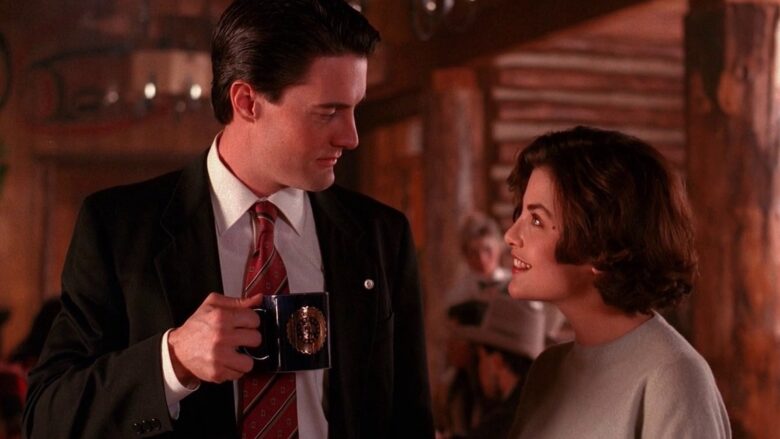
David Lynch is such an influential film and TV director that “Lynchian” became a commonly used term to describe dream logic, juxtapositions between light and dark themes, and inexplicable references to “The Wizard of Oz.” Lynch was a singular figure in Hollywood and “Twin Peaks” is one of the strangest hit series to ever air on American television. What appears at the outset as a classic murder mystery set in a small town reveals itself to be a much more complex story about cosmic trauma, the spiritual battle between good and evil, and the power of other worlds. Or, at least, that’s one way to look at it.
After its first two seasons aired on ABC in the early ’90s, “Twin Peaks” inspired countless television shows in its wake, though it’s difficult to describe what, exactly, makes a series similar to “Twin Peaks.” Is it a surreal tone? A foggy, small-town setting? An exploration of existentialism and the nature of the soul? A murder mystery with supernatural elements? In creating this list of the best shows like “Twin Peaks,” we’ve deployed all of these definitions to give you a diverse sampling of series that share certain qualities with Lynch and Mark Frost’s iconic television show.
Northern Exposure

The similarities between “Northern Exposure” and “Twin Peaks” aren’t hard to parse. They both follow eccentric outsiders moving to a small, mountainous town. In fact, parts of the two series were filmed only an hour apart in Washington’s lush Cascade mountain range. Both shows feature a beautiful waitress named Shelly — played by Mädchen Amick in “Twin Peaks” and Cynthia Geary in “Northern Exposure.” Viewers were so obsessed with connecting the dots between the two shows that the fifth episode of “Northern Exposure” includes an explicit reference to “Twin Peaks” in the form of a nonsensical sequence that references coffee, cherry pie, and the Log Lady — scored by some very familiar theme music.
Of course, tonally and narrative-wise, there are some pretty big differences between the shows. CBS’ “Northern Exposure” follows Joel Fleischman (Rob Morrow), a young doctor from New York City. Joel moves to Cicely, Alaska, to become the town doctor and experiences severe culture shock. The plot of “Northern Exposure” is comfortingly low-key. There’s no seedy underbelly to this quaint small town. Just people doing their best, making mistakes, and then righting them.
Still, “Twin Peaks” and “Northern Exposure” share an out-of-the-box sensibility, as “Northern Exposure” plays with magical realism and metatext. Shared dreams, ghosts, and someone’s boyfriend coming back to life as a dog are nothing to write home about for the residents of Cicely.
Wayward Pines
In “Wayward Pines,” a federal agent travels to a small Northwest town to investigate a case, only to find that town is loaded with dark secrets. Sound familiar? Like “Twin Peaks,” the underrated Fox series injects the story with melodrama and a sense of surrealism. Matt Dillon plays Ethan Burke, a Secret Service agent who wakes up in a disoriented state in the town of Wayward Pines, Idaho. He’s traveled there to investigate the disappearance of two of his colleagues, but something is very, very wrong. He’s unable to leave the town, nor can he contact anyone from the outside world. Though the townsfolk project a facade of niceness, there’s something devious going on underneath the surface. With a pilot directed by M. Night Shyamalan, you can expect some pretty big twists.
The series changes a lot by the second season, which, sadly, turned out to be its last, while also serving as a career springboard for the Duffer Brothers of “Stranger Things” fame. The ensemble cast of “Wayward Pines” is stellar, and includes the likes of Carla Gugino, who plays Ethan’s former partner, along with Toby Jones, Siobhan Fallon Hogan, and Shannyn Sossamon. Based on a trilogy of novels by Blake Crouch, the gone-too-soon series feels like “Twin Peaks” by way of Stephen King with Shyamalan’s brand of psychological surprises thrown in for good measure.
Fargo
Though all five seasons of “Fargo” take a different approach to storytelling, they each have an off-kilter quality that brings to mind the creepy strangeness of “Twin Peaks.” Inspired by the 1996 Coen Brothers film but featuring all-new characters, FX’s “Fargo” tells classic tales of good-hearted cops, crime bosses, crooked criminals, and regular folks committing murders with practiced weirdness. The anthology series features a staggering cast of accomplished actors, including, to name just a few, Billy Bob Thornton, Kirsten Dunst, Ewan McGregor, Carrie Coon, Jessie Buckley, Juno Temple, and Jon Hamm.
The secret sauce of “Fargo” is its chaotic depiction of people making terrible decisions and its expertly deployed pitch-black humor mixed in with that familiar Minnesotan niceness. Though grounded in the self-destructive nature of humanity, “Fargo” also features some out-of-this-world moments, including a surprising UFO plotline. According to “Fargo” creator Noah Hawley, “Twin Peaks” has been a huge influence on his work. “Certainly the mixture — the humor of the police station, the whimsy, the heightened folksiness, obviously is something we deal with on ‘Fargo’ as well,” he told Studio 360. While the title towns of the two shows possess their own distinct eccentricities, their oddball sensibilities feel spiritually connected.
Gravity Falls
“Gravity Falls” is sort of like “Twin Peaks” for kids, not that it only appeals to the under-18 set. One of the greatest animated Disney shows of all time, “Gravity Falls” centers on twins Dipper (Jason Ritter) and Mabel (Kristen Schaal). The duo live with their Grunkle — great-uncle — Stan (series creator Alex Hirsch) in the town of Gravity Falls, Oregon. Dipper and Mabel encounter supernatural phenomena all over town, and they learn more about the town’s secrets thanks to a mysterious journal they discover. Grunkle Stan, who runs a clearly fake museum, may be involved somehow, and sinister forces lurk beneath the surface.
“Gravity Falls” initially functions like a monster-of-the-week show such as “The X-Files,” though it slowly becomes clear that a terrifying Big Bad may be at play. The show’s surrealism recalls the offbeat, otherworldly tone of “Twin Peaks,” and creator Alex Hirsch once wrote that “Without [David] Lynch […] there’s no Gravity Falls. (My Bill Cipher voice was just a crummy Lynch impression).” “Gravity Falls” also features several explicit references to “Twin Peaks,” including a clever allusion to the Red Room. But more than that, “Gravity Falls” does a brilliant job introducing younger viewers to some of the themes explored in “Twin Peaks” and Lynch’s other works — exploring horror tropes without too much of a fear factor.
The X-Files
In Season 2 of “Twin Peaks,” David Duchovny plays Denise Bryson, a colleague of Dale Cooper (Kyle MacLachlan) at the FBI. (Denise also comes back for an essential scene in the 2017 relaunch season “Twin Peaks: The Return” on Showtime.) In 1993, Duchovny starred in a hit Fox show that bears more than a passing resemblance to “Twin Peaks.” In “The X-Files,” Duchovny plays FBI Agent Fox Mulder, an expert in behavioral analysis with a passion for the supernatural. He’s paired with Dana Scully (Gillian Anderson), a scientist focused on rationality and the perfect foil to Mulder’s exuberance. Even if you’ve never watched “The X-Files,” you know Mulder and Scully — they’ve inspired countless odd-couple pairings in the years since and might as well have literally invented the concept of internet “shipping.”
The two shows feel creatively linked, despite key differences. Both shows traffic in the supernatural and the surreal, going so far as to leave certain plotlines unresolved for maximum mysteriousness. “The X-Files” is much more of a procedural than “Twin Peaks,” and was more expansive in its blending of genres, but they share a playful sense of humor and an interest in the bizarre that certainly endears fans of one to the other.
Bates Motel
Speaking at a Paley Center panel in 2013, “Bates Motel” co-creator Carlton Cuse was up front about his influences for the show. “We pretty much ripped off ‘Twin Peaks,'” he joked. “I loved that show. They only did 30 episodes. [Co-creator] Kerry [Ehrin] and I thought we’d do the 70 that are missing.”
The “Twin Peaks” influence is hard to miss. “Bates Motel” on A&E serves as a prequel to Alfred Hitchcock’s “Psycho,” though it’s set in the present day. Like “Twin Peaks,” it feels out-of-time — nostalgic but in an eerie, off-kilter way. Both shows are set in the Pacific Northwest, amongst fog and evergreen trees. Psychological distress and murder serve as jumping-off points for surprising plotlines, though the ultimate endpoint of “Bates Motel” is a foregone conclusion.
In this version of the story, Vera Farmiga plays Norma Bates; her unusual son, Norman, is played brilliantly by Freddie Highmore. (Oddly enough, Timothée Chalamet auditioned for the role). Violence and danger hide behind the picturesque views and fragrant pine needles, and toxic family relationships are the name of the game. “Bates Motel” may have reheated some “Twin Peaks” nachos, but the result is one delicious plate of food.
Fringe
The most obvious precedent for the TV series “Fringe” is “The X-Files,” but beneath that is a strong connection to “Twin Peaks.” The Fox show follows Olivia Dunham (Anna Torv), an FBI agent assigned to the mysterious Fringe Division. She works with Walter Bishop (John Noble), an eccentric scientist, his formerly estranged son Peter (Joshua Jackson), and Junior Agent Astrid Farnsworth (Jasika Nicole). They’re led by the tight-lipped Phillip Broyles (Lance Reddick). The Fringe Division was created to investigate instances of unexplained phenomena, which may appear supernatural or scientifically impossible.
The series was created by J. J. Abrams, Alex Kurtzman, and Roberto Orci, who all brought their own influences to the show. Speaking with The Futon Critic, Orci revealed that his “touchpoint” was the Val Kilmer film “Real Genius,” while Abrams was inspired by David Cronenberg and “The Fly.” Meanwhile, “Alex was a big ‘Twin Peaks’ fan, so he wanted that sort of surrealistic FBI element to it.”
Abrams attempted to make “Fringe” more straightforward than “Lost” and its spiritual predecessor “Twin Peaks,” and the result is a sci-fi epic with characters at its center. The show explores the possibility of multiple worlds — some we all can see, some visible only to the most observant, and others that only appear to us in dreams. “Fringe” also features several references to “Twin Peaks,” including a mention of Dr. Jacoby (Russ Tamblyn) and an episode called “Northwest Passage,” which shares its name with an early suggested title for the show that became “Twin Peaks.”
The Leftovers
Damon Lindelof is on the record discussing his love for “Twin Peaks.” The creator of “Lost,” “The Leftovers,” and “Watchmen” told Time, “There is no show in television history that had more impact on me than ‘Twin Peaks.'” Though both “Lost” and “The Leftovers” bear the mark of David Lynch’s influence, “The Leftovers” is our favorite of the two shows.
One of the best TV shows of the 21st century, HBO’s “The Leftovers” offers a unique look at the apocalypse. The show begins three years after 2% of the world’s population abruptly disappeared with no explanation whatsoever. Life goes on for most, but everyone is touched by loss in some way. Kevin Garvey (Justin Theroux), a police chief in a small town, is at the center of the action, and he struggles to reckon with his wife’s (Amy Brenneman) decision to join a cult called the Guilty Remnant. Meanwhile, Nora (Carrie Coon) faces life alone after her entire family disappears.
“Twin Peaks” is less concerned with solving Laura Palmer’s murder than it is with exploring how it affected everyone in the town. “The Leftovers” takes a similar approach to the central mystery, focusing on the destabilizing nature of grief rather than the “What?” or “Why?” of it all. Less frustratingly byzantine than “Lost,” “The Leftovers” is a rewarding slow-burn that revels in Lynchian ambiguity.
Dark
The German series “Dark” is a personal favorite of Stephen King and it strikes a uniquely unsettling chord. “Dark” takes place in the small German town of Winden. The events of the series begin in 2019, following the disappearance of two children. As the townsfolk investigate the disappearance, they’re drawn toward a mysterious cave that may hold the secret to time travel. Subsequently, the plot shifts between several decades, as we learn that children have been disappearing from Winden for a long time.
Like “Twin Peaks,” Netflix’s “Dark” delves into surrealism and existentialism and exposes the sinister underbelly of a small town. Both shows feature interesting, colorful characters that would keep our attention regardless of any overarching mystery. Folks frustrated with Lynch’s penchant for not explaining things may appreciate the intricate storytelling of “Dark,” though it demands you pay close attention. Like “Lost,” another “Twin Peaks” descendant, “Dark” functions like a mystery box, and it all builds to a mesmerizing season finale that pulls all the threads together. Almost every episode features a mind-boggling twist that would be major water-cooler fodder if we still had water coolers.
The OA
We still haven’t forgiven Netflix for canceling “The OA” and ending the show on a cliffhanger, but it’s not surprising that some folks couldn’t wrap their heads around the outlandish brilliance of co-creators Brit Marling and Zal Batmanglij. Like “Twin Peaks,” “The OA” is a bizarre show that requires viewers to take a leap of faith. Marling plays Prairie Johnson, returning home after seven years missing. When she left, she was blind; now she can see again.
Calling herself the OA, or the Original Angel, she decides to reveal her secrets to a select group of five locals including one played by Phyllis Smith of “The Office.” As she weaves her fantastical tale, her chosen disciples must decide if they believe in their new prophet and her mission, which involves rescuing others from the man who held her captive. It might also have something to do with a portal to another dimension?
Like “Twin Peaks,” “The OA” sends the viewer through a wormhole and into a world where reality and dreams blur. Both shows have a habit of sidestepping the answers to our questions, bending the concept of truth with a wry grin. But while “The OA” certainly feels indebted to the work of David Lynch, it’s also incredibly unique, and Marling and Batmanglij’s voices seem to bubble up from a celestial wellspring of creativity of which only they have access.