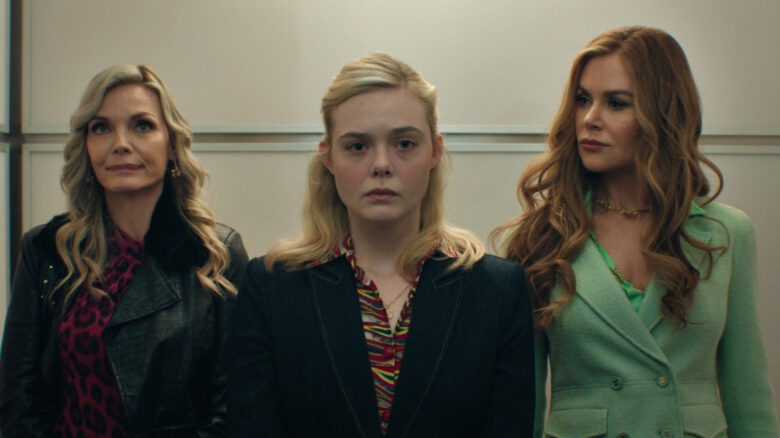
Apple TV found another hit with “Margo’s Got Money Troubles.” Based on a novel by Rufi Thorpe, the series stars Oscar nominee Elle Fanning as the titular young woman, a college dropout who turns to OnlyFans to support herself and her new baby. Its star-studded supporting cast includes Nick Offerman as Margo’s father, a former pro wrestler, Michelle Pfeiffer as Margo’s withholding mother, and Nicole Kidman as a former wrestler turned lawyer.
Since Apple TV confirmed that “Margo’s Got Money Troubles” is renewed for Season 2, fans of the series might have to wait a while for more episodes to hit the streamer. Thankfully, there are plenty of shows like “Margo’s Got Money Troubles” that combine a lot of the show’s best qualities: imperfect female leads, empowering storylines, colorful world-building, and, of course, sexual liberation. These ten shows should help fill the gap until Margo returns.
The Great

Of course, we can’t recommend shows like “Margo’s Got Money Troubles” without mentioning Elle Fanning’s previous series centered on a powerful woman. In “The Great,” Fanning plays Russian monarch Catherine the Great, fictionalizing her marriage to Peter III (played by Nicholas Hoult) and her plot to kill him to usurp power. Though its status as a period piece makes it seem vastly different from Fanning’s work in “Margo’s Got Money Troubles,” the shows actually have a lot in common in terms of tone.
Namely, “The Great” is not a series made for scholars of the Russian monarchy, often going against historical accuracy to portray Catherine’s life as a chaotic series of farces and petty squabbles between an unhappy couple. Given that “The Great” was created by Tony McNamara — who earned Oscar nominations for writing Yorgos Lanthimos’ “Poor Things” and “The Favourite” — it’s no surprise that the Hulu series is as hilarious as it is sexually promiscuous, and Fanning’s performance is often a highlight just as it is in “Margo’s Got Money Troubles.”
“The Great” ran for three seasons before Hulu cancelled it, ending one of the platform’s most distinctive comedies. We’re at least glad that Fanning has a new series that gives her a platform to be at least half as funny as she is as Russia’s longest-ruling female monarch.
Vida
“Vida” may have only run for three seasons starting in 2018, but several years later, it’s still one of the most progressive female-led shows of its era. Melissa Barrera and Mishel Prada star as Lyn and Emma, respectively, both daughters of their late mother, Vidalia (the titular “Vida”), who discover they now co-own the family bar with their mother’s secret wife, Eddy, played by Ser Anzoategui.
Barrera’s character, in particular, feels the most analogous to Elle Fanning’s Margo from “Margo’s Got Money Troubles,” given they’re both free-spirited women whose sexual freedom and personal agency play a major role in their character arcs. “Vida” also heavily focuses on the complicated relationships both daughters had with their mother, which should be familiar territory for those who enjoyed watching the messy dynamic between Fanning and Michelle Pfeiffer’s Shyanne in the Apple TV show.
Though the show was cancelled at Starz after three seasons, Barrera’s performance and the show’s unapologetic portrayal of Mexican-American generational trauma make it one of the most memorable dramas of its era.
Mrs. Fletcher
Whereas “Margo’s Got Money Troubles” explores how the younger generation can utilize the Internet to profit off their sexual identities, HBO’s “Mrs. Fletcher” shows how the older generation utilizes it to explore their own. Kathryn Hahn is one of the finest TV character actors of all time, but a show like “Mrs. Fletcher,” where she gets to play the lead, was long overdue by the time it aired in 2019.
Based on a novel by Tom Perrotta, “Mrs. Fletcher” stars Hahn as Eve Fletcher, who, after her son empties the nest for college, prompts her to explore a sexual reawakening that includes watching pornography, trying out new kinks, and having one-night stands with strangers. Meanwhile, the show also follows her son, Brendan (Jackson White), who is frequently caught in the crossfire between his divorced mother and father, while also facing a massive wake-up call at college thanks to his cocky attitude.
Like “Margo’s Got Money Troubles,” the show explores the modern world of sex through both an older generation’s eyes and a younger generation’s. Hahn especially delivers a firecracker performance as a sexually-frustrated older woman exploring her sexual liberation, which is not a far cry from Fanning’s take on the empowered and free-spirited Margo.
Secret Diary of a Call Girl
There aren’t many television shows that portray the field of sex work as nuanced as it really is, but thankfully, “Margo’s Got Money Troubles” has a worthy predecessor in ITV’s “Secret Diary of a Call Girl.” Billie Piper stars in the series as Hannah, who takes on a secretive career as an escort in pursuit of money despite her college education. Along the way, Hannah struggles to keep her real life hidden from her friends and family, and eventually becomes a mentor to a naive newer escort named Bambi (Ashley Madekwe).
Even though the series originally aired from 2007 to 2011, its depiction of sex workers is far more progressive than a lot of other shows at the time, mainly due to Piper’s bold portrayal of Hannah as a smart and confident young woman. Hannah’s double life as “Belle de Jour” simultaneously allows her to exercise the freedom she doesn’t otherwise have in her life, as well as make a more-than-decent living, not dissimilar to Fanning’s Margo.
Though it might be an awkward watch, especially if you’re more used to seeing Piper as Rose in the TV revival of “Doctor Who,” it’s a surprisingly refreshing take on a career path that’s often misrepresented in film and television. Like “Margo’s Got Money Troubles,” hopefully, people walk away from “Secret Diary of a Call Girl” with a deeper understanding of sex workers’ lives.
GLOW
If you wish there were more professional wrestling in “Margo’s Got Money Troubles,” then you should probably watch one of the sexiest shows on Netflix: “GLOW,” a dramedy series fictionalizing the behind-the-scenes of an obscure ’80s TV program titled “Gorgeous Ladies of Wrestling.” Alison Brie stars as Ruth, a desperate actress whose big break on “GLOW” is jeopardized when the curmudgeon director, Marc Maron’s Sam, also casts her ex-best friend Debbie, played by Betty Gilpin.
“GLOW” is much more of an ensemble comedy than “Margo’s Got Money Troubles,” but given the connection to pro wrestling and how it tackles themes such as sexual liberation, women’s empowerment, and substance abuse, it’s an obvious recommendation to anyone who enjoyed the Apple TV series but maybe missed out on this acclaimed Netflix dramedy.
Sadly, “GLOW” was cancelled by Netflix despite a fourth season renewal, and a future for the series seems unlikely at this point as its cast has moved on to other projects. However, the focus on wrestling in “Margo’s Got Money Troubles,” as well as cameos from pro wrestlers like Chris Jericho and Rikishi, makes it feel like the series is carrying the baton from the wrestling dramedy that came before it.
If you or anyone you know needs help with addiction issues, help is available. Visit the Substance Abuse and Mental Health Services Administration website or contact SAMHSA’s National Helpline at 1-800-662-HELP (4357).
On Becoming a God in Central Florida
“On Becoming a God in Central Florida” doesn’t have anything to do with OnlyFans or professional wrestling, but it does follow another woman rising from financial ruin to prosperity through her own ingenuity and, more importantly, unapologetic personality. Kirsten Dunst stars in the Showtime series as Krystal, a woman who becomes involved in a multi-level marketing business (aka a pyramid scheme) that propels her from working in an Orlando water park to becoming a successful entrepreneur.
Compared to “Margo’s Got Money Troubles,” “On Becoming a God in Central Florida” plays out almost like a crime series, as the stakes get higher and Krystal’s willingness to risk anything for financial gain gets more and more desperate. Along the way, the show also recruits both a strong supporting and guest cast, just like Apple TV’s show, including Alexander Skarsgård, Mary Steenburgen, and Mel Rodriguez. Nevertheless, both shows share a deeply flawed female protagonist, albeit Margo is much easier to root for than Krystal.
Sadly, Showtime reversed its Season 2 renewal of “On Becoming a God in Central Florida” due to the COVID-19 pandemic, putting a premature end to what could’ve been a continued hit for Showtime.
Dickinson
On paper, a TV series about Emily Dickinson doesn’t exactly seem like the type of show that’s comparable at all to something like “Margo’s Got Money Troubles.” However, the two shows have a lot more in common than being on the same streaming service. Apple TV’s “Dickinson” was one of the streamer’s earliest hits, starring Hailee Steinfeld as the titular poet, who is frequently petulant in response to the societal norms restricting women, which forces her best friend and lover, Sue (Ella Hunt), to marry her brother.
Though you won’t find Emily Dickinson creating an OnlyFans in the series, the way the show tonally depicts 19th-century New England is not far off from modern day, often satirizing the archaic way of life and even roping in famous comedians to play Dickinson’s contemporaries, including John Mulaney as Henry David Thoreau and Nick Kroll as Edgar Allan Poe.
More than anything, though, “Dickinson” draws comparisons to “Margo’s Got Money Troubles” due to its depiction of Dickinson as a sexually experimental young woman, whose sexuality is a driving force of much of the show’s emotional narrative. It may not satisfy viewers looking for strict historical accuracy, but its contemporary approach to relationships and sexual liberation feels surprisingly similar to “Margo’s Got Money Troubles.”
The Marvelous Mrs. Maisel
Speaking of period pieces, “The Marvelous Mrs. Maisel” jumps forward in time about 100 years from “Dickinson” to place us roughly 70 years before the modern setting of “Margo’s Got Money Troubles.” Amy Sherman-Palladino’s shows, namely her previous hit “Gilmore Girls,” are a far cry tonally from the grounded realism of “Margo’s Got Money Troubles,” but you can easily make a comparison between Fanning’s titular mom-turned-sex worker and Rachel Brosnahan’s mom-turned-stand-up comedian.
“The Marvelous Mrs. Maisel” stars Brosnahan as Midge, a housewife in the 1950s who, after her husband abruptly leaves her for his secretary, drunkenly stumbles into a Greenwich Village comedy club and rants on stage, attracting the attention of not just the authorities, but also opportunistic club manager Susie (Alex Borstein), who offers to help Midge pursue a real career in comedy. Though it’s a far less promiscuous show than “Margo’s Got Money Troubles,” Midge’s true self, being foul-mouthed, reckless, and prone to scandal, isn’t much different from Margo’s innate free-spiritedness.
Though Midge’s journey looks very different from Margo’s, her struggle to build an independent life on her own terms gives “The Marvelous Mrs. Maisel” much of its empowering appeal. Like Margo, she’s forced to reinvent herself after her life takes an unexpected turn, making the two characters more similar than they initially appear.
The Queen’s Gambit
Netflix’s drama “The Queen’s Gambit” made Anya Taylor-Joy a star and made chess sexy, but it doesn’t need to be actually sexually explicit to do so. The miniseries, based on Walter Tevis’ novel, stars Taylor-Joy as Beth Harmon, an orphaned chess prodigy who rises through the ranks in the world of competitive chess, all while battling an addiction to drugs and alcohol that worsens as she becomes more and more successful.
In a way, “The Queen’s Gambit” is a similar type of story to “Margo’s Got Money Troubles,” showing that life isn’t all rags-to-riches, as sometimes the riches can be a lot more dangerous than the rags were. Beth’s characterization is among the best in recent TV history, but her reckless behavior, proclivity to substance abuse, and profound sense of isolation make her character arc just as compelling to watch as Elle Fanning’s as Margo in “Margo’s Got Money Troubles.”
Though there will likely be no future seasons of the Netflix series at this point, the show’s critical acclaim, commercial success, and pop culture impact make it one of Netflix’s most memorable dramas.
If you or anyone you know needs help with addiction issues, help is available. Visit the Substance Abuse and Mental Health Services Administration website or contact SAMHSA’s National Helpline at 1-800-662-HELP (4357).
Fleabag
When you’re recommending series like “Margo’s Got Money Troubles” that touch on modern sexuality and dysfunctional family dynamics, you can’t forget to mention “Fleabag.” The BBC series began as a one-woman stage show written and performed by its creator and star, Phoebe Waller-Bridge, before being adapted to television in 2016. It follows the titular anti-heroine, a sexually promiscuous, cynical, misfit young woman grappling with the death of her best friend, Boo, and trying to financially maintain the small cafe they ran together.
Though you can draw obvious parallels between Margo’s financial need to support her child and Fleabag’s desire to keep her friend’s memory living on through her business, the real similarity between the shows is how deftly they move between comedy and drama. Though “Margo’s Got Money Troubles” is quite good at it, no one in television has mastered the tonal shifts like Waller-Bridge.
If the first season’s not enough for you, Season 2 of “Fleabag” also happens to be one of the best final seasons of TV shows ever made.