There’s something about animation that brings out the best in sitcoms. Be it the visual flexibility, relatable storytelling, or potential for absurdism with little need for justification, cartoons have historically been a great source for comedy in the episodic, situational format. In fact, several of the wildest, most interesting, and just out-and-out funniest sitcoms of all time are animated.
Sure enough, every show on this list of the 15 best animated sitcoms ever made deserves to make any list of the best sitcoms of all time. In one way or another, they all left their mark on both the genre and the world of television at large, and their best episodes remain as hilarious now as they ever were. Naturally, “sitcoms” means that this list will not include slapstick cartoons or heavily serialized shows in the fantasy, sci-fi, or adventure genres. To stay on topic, we’re also going to avoid anything that skews too dramatic.
15. Family Guy

Arguably the TV show that most defined the chaos of 21st century humor (for better or worse), “Family Guy” has managed to endure as a cultural staple across multiple generations, and may well be the only 27-year-old show on Earth that’s just as likely to be quoted by 50-year-olds as it is teenagers.
Originally premiered on Fox in January 1999, Seth MacFarlane’s family sitcom has consistently followed the same core cast throughout its 24 seasons: Titular patriarch Peter Griffin (MacFarlane), his stay-at-home wife Lois (Alex Borstein), their teenage children Meg (Lacey Chabert and Mila Kunis) and Chris (Seth Green), their Machiavellian toddler Stewie (MacFarlane), and anthropomorphic family dog Brian (MacFarlane). The Griffins go through various absurd misadventures around the fictional Rhode Island city of Quahog.
While “Family Guy” has become infamous among even its most devoted fans for the series’ wild inconsistency and over-reliance on cutaway gags and pop culture shout-outs, there’s a reason it has had such staying power. Thanks to a postmodern dedication to stacking the deck with gags, the best “Family Guy” episodes are as funny, inventive, and irreverent as anything American TV has ever seen.
14. Harvey Birdman, Attorney at Law
The early years of Adult Swim were brimming with shows that reimagined properties from the Warner and Hanna-Barbera vaults within a new, tongue-in-cheek context. The most emblematic of these series was, arguably, “Harvey Birdman, Attorney at Law” — a courtroom comedy that cast ’60s “The Galaxy Trio” superhero Harvey Birdman (now voiced by Gary Cole) as a grandstanding lawyer at a firm made up of, and mostly representing, Hanna-Barbera icons.
One of the pioneers of Adult Swim’s brand of surreal, non-sequitur-based comedy, “Harvey Birdman” deftly balanced deconstructing classic cartoon lore — like a Season 1 case in which Shaggy and Scooby-Doo are accused of marijuana use — with casual workplace sitcom antics at the firm. Through its endlessly clever writing and savvy incorporation of genre tropes, it managed to be an equally hilarious show, whether you came to it as a longtime Hanna-Barbera aficionado or a first-timer with no foreknowledge of the characters being skewered.
13. Bob’s Burgers
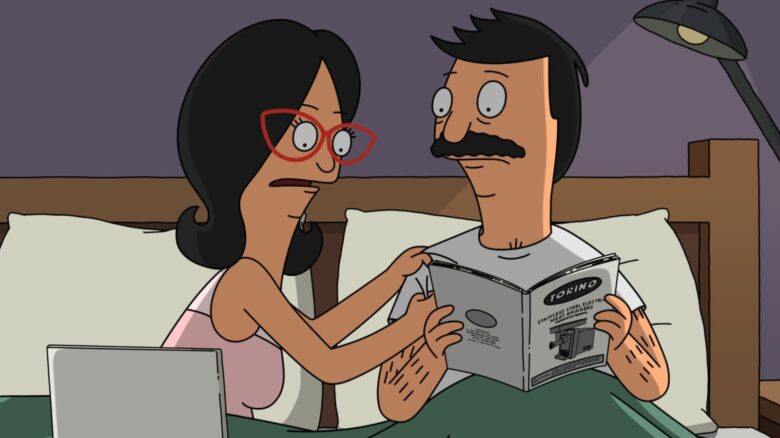
The pantheon of adult animated sitcoms gained a new member in 2011, when Fox began airing the Loren Bouchard-created “Bob’s Burgers.” Since then, it’s been 16 seasons and over 300 episodes of pure comedic bliss, making up the strongest body of work of any conventional animated sitcom in ages. Then again, “conventional” may be the wrong word to describe “Bob’s Burgers.”
The series managed to freshen up the age-old family comedy template by playing the hits — snappy writing, strong characters, a sprawling and imaginative inner world with a sense of pathos that doesn’t get in the way of the fun — while always staying on the lookout for ways to flip the script. The story of Bob Belcher (H. Jon Benjamin) and his family-run New Jersey burger joint strikes an impeccable balance between low-key, relatable, sharply-observed mundanity (complete with three of the wildest yet most believable TV kids ever), and unpredictable flights of fancy. More impressively, the show has managed to do so without significant dips in quality for over a decade and a half now — a longer winning streak than golden-age “The Simpsons,” to which this uniquely special show has become the de-facto heir apparent.
12. The Amazing World of Gumball
Adult Swim and a handful of ’90s Hanna-Barbera productions aside, Cartoon Network has not historically been defined by animated sitcoms. True to the brand name, generational classics like “The Powerpuff Girls,” “Adventure Time,” “Dexter’s Laboratory,” “Courage the Cowardly Dog,” and “The Marvelous Misadventures of Flapjack” have been closer in spirit to “Looney Tunes,” freely stretching and bending the hand-drawn image for the purposes of slapstick, satire, fantasy, and imaginative exuberance.
What makes “The Amazing World of Gumball” extraordinary — and, indeed, one of the best Cartoon Network shows of the 2010s — is that it simultaneously subscribes to that tradition and sidesteps it, showcasing what a classic, couch-and-TV family sitcom can look like with the full expressive power of Cartoon Network’s animation behind it. The result, to put it succinctly, is a triumph of the medium. “Gumball” combines rambunctious experimental animation (the best and most creative of any show on this list) with sophisticated enough writing to rival any live-action postmodern sitcom (think “Soap” by way of “Community”), and turns the trials of a suburban clan of anthropomorphic animals into an unlimited buffet of laughs and surprises.
11. The Critic
The world may not have been quite ready for “The Critic” in the ’90s. Originally aired for just two seasons between 1994 and 1995, this brainy, envelope-pushing New York City observational sitcom was originally overshadowed by “The Simpsons” (with which it shared multiple creatives, a Gracie Films production tag, and later a Fox home), and never quite won over mainstream audiences with its story of a divorced movie critic (Jon Lovitz) trying to stay true to his grouchy principles amid an increasingly art-averse film industry. Seen today, however, “The Critic” is prophetic.
In his snarky, proudly buzz-killing voice, Jay Sherman diagnosed the money-grubbing downward spiral of American entertainment just as it was beginning to take shape, and offered cutting insight on then-fictional pop culture trends years — or even decades — before they actually materialized in the real world. The show, meanwhile, honors Jay’s perspective while dutifully poking holes in his sense of East Coast intellectual self-importance, laying bare the absurdity of his own milieu via droll, frequently surreal writing (including ample use of cutaways years before “Family Guy”). It was a series unconcerned with pleasing or placating anyone — which is precisely what made it brilliant.
10. Tuca & Bertie
No show exemplifies the thrilling horizons chased by contemporary TV animation better than “Tuca & Bertie.” Created by Lisa Hanawalt, who made her name as a production designer and producer on “BoJack Horseman” (a show that would make this list if not for being so intensely dramatic), “Tuca & Bertie” follows Tuca Toucan (Tiffany Haddish) and Roberta “Bertie” Songthrush (Ali Wong), two best friends living in the same apartment complex and helping each other through the maddening tribulations of modern adulthood.
Despite taking place entirely in a world made up of anthropomorphic animals, the series broaches the realities of urban life smartly and perceptively. The daily adventures of Tuca and Bertie frequently take off from slice-of-life quaintness, into levels of strangeness and surrealism only permitted by animation, but there’s always a painfully relatable emotional core underlying the psychedelia. It’s a series that exemplifies the power of the cartoon medium to reveal the world by reimagining it.
9. Rick and Morty
Nine seasons in, the memefication of “Rick and Morty” has reached such nuclear, planet-sized levels that it very nearly eclipses the show itself in the public imagination. In a sense, it’s a testament to the greatness at hand that a bizarre experimental sci-fi show about a reality-hopping dysfunctional family could become the biggest mainstream success story in 21st-century adult TV animation. But you could just as well see the “Rick and Morty” cultural phenomenon as a kind of double-edged sword — a layer of caricature belying the sensitivity and creativity behind one of the all-time great existential comedies.
Beneath the snazzy action sequences, comical ultra-violence, and jagged potty humor, “Rick and Morty” is uniquely skilled at using its anything-goes multiverse and nearly god-like scientific powers of Rick Sanchez (Justin Roiland and Ian Cardoni) to tell profoundly compelling, frequently gut-wrenching, stories about the sheer toll of being alive, searching for meaning, and dealing with your own failings in a brutally indifferent space-time continuum. The most essential “Rick and Morty” episodes do all that while remaining hilarious, in ways far beyond the average sitcom.
8. Futurama
If “Rick and Morty” makes a spectacle of breaking apart the template of animated sci-fi comedy, “Futurama” is the show that created that template in the first place — while still engaging in plenty of its own cheeky misbehavior. To boot, it also set the mold for how to follow up legendary work as a TV auteur: Here was the show where Matt Groening, fully aware of the impossibility of meeting the level of expectation set by masterminding “The Simpsons,” wisely went about doing something entirely new, — not just in his oeuvre, but in the broader canon of American television.
Structurally, “Futurama” hews to the basics. Its story of universe-spanning hijinks in the 31st century essentially boils down to a stop-of-the-week office sitcom about a ragtag group of delivery people, featuring one of animation’s most endearing and best-developed ensemble casts ever. But, it’s in the execution of those loopy adventures that “Futurama” reveals itself as the perfect midpoint between the dry, organized classicism of animated sitcoms past and the boundlessness of their future, drawing from an infinite supply of imagination and wit to yield indelible satirical tales about humanity’s potential horizons. “Futurama” is one of the shows that defined the sci-fi genre, and it’s easy to see why.
7. South Park
The worldwide definition of vulgar television — if not in all audiovisual media — was codified by “South Park.” Created by Trey Parker and Matt Stone, and digitally animated to resemble the cutout technique of its pilot episode, the Comedy Central classic has been a 300-plus-episode experiment in pushing the boundaries of TV with the most deliberately crude-looking visuals possible. On that level alone, it’s a historical, culture-redefining triumph.
In addition to the taboos routinely pulverized by its absurdist storytelling focused on small-town Colorado school friends Stan Marsh (Parker), Kyle Broflovski (Stone), Eric Cartman (Parker), and Kenny McCormick (Stone), “South Park” holds the honor of being one of the funniest shows of all time. The series’ highly topical, wide-ranging satire has been a subject of heated debate over the years, but the true legacy of “South Park” is less what points it may or may not have made about American politics, and more how successfully it has turnee the wheel of the 21st century into a pageant of gleeful, gut-busting debauchery.
6. Daria
Created by Glenn Eichler and Susie Lewis Lynn, MTV’s “Daria” is the greatest animated sitcos to focus on high school students. A spin-off of “Beavis and Butt-Head” that took on a vibrant life of its own, it stars Tracy Grandstaff as Daria Morgendorffer, a cynical, erudite, perpetually unimpressed high schooler who treks through the mire of suburban teen life with scathing wit as her weapon of choice.
Like a miniature Dorothy Parker, Daria provides stinging commentary on everything that she sees around her, from the farcical pecking order of her school, to the circular middle class habits of her family and her neighborhood — all while offering up her own relatable insecurities and awkward coming-of-age pains for our storytelling investment. “Daria” is both a perfect sitcom — attentive to shades of pithy realism and mundane buffoonery alike – and a phenomenal show about the unsolvable problem of growing up.
5. King of the Hill
We rarely get shows about what it’s truly like to get through the world as an average Middle America family. Leave it to an animated series to do the job: “King of the Hill” is both the funniest and sharpest representation of the lived realities of blue-collar life that American television has seen in at least three decades. And what’s extra wonderful is that the show manages to be that without ever letting on its level of ambition.
In fact, on the surface, “King of the Hill” looks like the most self-effacing show of all time: We watch Hank (Mike Judge), Peggy (Kathy Najimy), and Bobby Hill (Pamela Adlon) as they deal with everyday problems and frustrations, convene and bicker with neighbors, and just try to keep their ship afloat in a Texas city much like any number of American small towns. But the series’ handling of that outwardly simple premise is so flawless, so brilliantly characterized and written, so hysterical in its searing recognizability (with help from animation rules that set it apart), that it reaches full-blown masterpiece status. No wonder it’s been so widely beloved for so long.
4. The Flintstones
It’s no exaggeration to say that animated sitcoms would not be a thing if not for “The Flintstones” — not only because the Hanna-Barbera prehistoric classic is the blueprint for every subsequent cartoon sitcom, but because its smashing success made the sub-genre an industry hot item. For the entire stretch between its 1966 conclusion and the launch of “The Simpsons” in 1989, virtually every primetime animated series wanted to be the next “The Flintstones.”
In their own way, the tales of the Flintstone and Rubble families, and their anachronistic parade through tropes of American suburbia, were as foundational to our understanding of midcentury U.S. life as “I Love Lucy.” While this also means that certain episodes and recurring motifs of “The Flintstones” have aged less than gracefully, it’s still wondrous to see the comic mileage the series’ writers and animators were able to get out of pun-heavy cultural mock-ups, living dinosaur appliances, and an effective core cast of four great characters.
3. The Boondocks
As cultural commentary, relevance, and satirical bite go, no other 21st-century sitcom — animated or otherwise — stands taller than “The Boondocks.” Adapted by Aaron McGruder from his own eponymous comic strip, the trailblazing Adult Swim series tackled all the complexities and hot topics of Black American life in its time, leaving no stone unturned nor controversy unaddressed; Its three original seasons are like a real-time log of the transformations in American political discourse over the second half of the 2000s.
Even leaving aside its brilliance as satire, “The Boondocks” deserves praise as a phenomenally funny, innovative, and energetic example of its genre. Featuring crisp anime-inspired animation that adds panache and style to every moment, this is a show that looks and moves unlike anything else seen on TV, and avails itself of that formal vigor to deliver incredible punchlines and unforgettable characters at a relentless clip. And Regina King’s work as brothers Huey and Riley Freeman puts in a strong claim for best voice acting performance in the history of animated sitcoms.
2. SpongeBob SquarePants
There’s still no good explanation for how “SpongeBob SquarePants” was allowed to happen. Who could have possibly put any stock in the idea that a surrealistic cartoon about obscure undersea invertebrates (and one squirrel), created by a marine biologist and featuring a Jacques Cousteau-spoofing French narrator (Tom Kenny), could ever even achieve mainstream success — let alone become the most iconic and ubiquitous program in the history of Nickelodeon? And yet, somehow, that’s just what Stephen Hillenburg’s “SpongeBob” did, by dint of its sheer creativity and comic brilliance.
Granted, like many of the most popular animated shows, “SpongeBob” became so huge that it eventually lived long past its last traces of top-form quality, and largely became a glossy, unfunny husk of its former self. But, for those three original seasons on which the series was firing on all cylinders, there was nothing else on TV quite as original, hilarious, or witty. To some extent, every family-oriented animated sitcom made since has been trying to make good on the lessons taught by golden-era “SpongeBob” — and none have quite managed to match the beat-for-beat perfection of its writing and animation.
1. The Simpsons
There’s TV before “The Simpsons,” and TV after it. Actually, scratch that: There’s American culture before “The Simpsons,” and American culture after it. Actually, scratch that, too: There’s a world before, and another after, the Fox animated sitcom, which impacted media, comedy, entertainment, and the United States’ self-image so thoroughly and profoundly, it’s next to impossible to imagine a parallel reality without it.
Really, with how unfathomably enormous “The Simpsons” became in the ’90s — to the point of casting a long shadow over 21st-century pop culture even as its ratings and relevance wane dramatically — it’s a wonder it took as long as it did for the show to jump the shark. Any other production that enjoyed the Olympian levels of popularity and acclaim that “The Simpsons” reached by its third or fourth season would have immediately defaulted to coasting on goodwill for the rest of time. Instead, peak “The Simpsons” remained committed to being the greatest sitcom of all time — a masterclass in structure, timing, storytelling, world-building, character creation, and social satire that played out like a never-ending sequence of all-time gags. Number one on this list couldn’t be anything else.