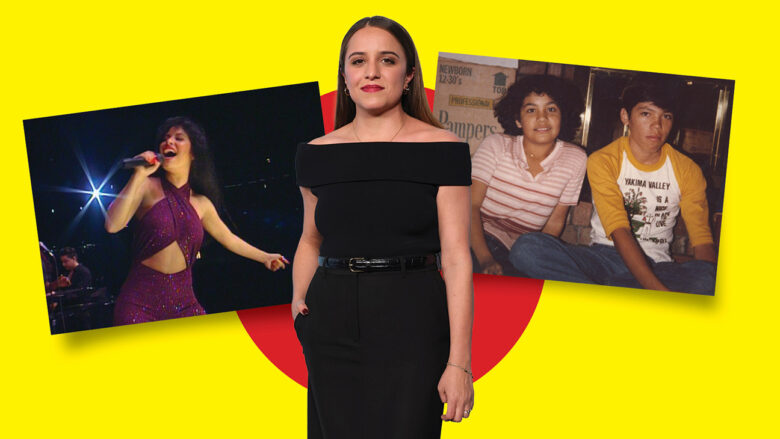
When Selena y Los Dinos: A Family Legacy director Isabel Castro was first approached by members of Selena Quintanilla‘s family about making a documentary about the legendary Tejano singer, she was a little apprehensive.
“I was honored and excited but also unsure of how we were going to be able to do it differently,” Castro says, as the performer’s life has been well covered in the media, most notably in the 1997 biopic Selena, directed by Gregory Nava and starring Jennifer Lopez.
And then the Quintanilla family opened up their archives. During Castro’s first trip to Corpus Christi, Texas, where Selena was raised, she was introduced to a room they call “the vault,” a floor-to-ceiling treasure trove of VHS tapes, DVDs and flash drives, that would form the backbone of her film, which landed on Netflix in November.
Over the course of two years, she and producer J. Daniel Torres traveled to Corpus Christi more than a dozen times to comb through the hundreds of hours of footage. And that was before Castro started to interview Selena’s relatives, including her father and manager, Abraham, who died in December, and her mother, Marcella.
Selena’s brother and sister, A.B. and Suzette, are executive producers of the documentary, which chronicles how what was initially a family band, Los Dinos, resulted in Selena’s emergence as a global superstar. “In getting to know them and getting to know their role, I thought it was really important that the world knows their involvement,” Castro says of Suzette, who played drums for the band, and A.B., who was bass guitarist and also produced and co-wrote many of Selena’s hit singles.
Castro’s North Star was her desire to essentially make a coming-of-age story showing how Selena, who died when she was just 23, evolved as a singer-songwriter and pioneering crossover artist, as well as a businesswoman, in such a short amount of time at a very young age. “It was really important that people get to know her as not just this symbol that has become so meaningful to people like me, but as a young woman so that they could understand the incredible weight of what she accomplished,” Castro explains.
As such, the director was intentional about not placing too much focus on the circumstances of Selena’s murder at the hands of Yolanda Saldívar on March 31, 1995.
“There’s an impulse to understand this horrible tragedy that happened. So, oftentimes, in the recounting of Selena and her story, that part of her story ends up taking up more real estate than I think it deserves,” says Castro. To dwell on that, she believes, would have taken away from her chronicle of Selena’s legacy. Getting to know that chronicle intimately came with a bittersweet reality.
“I’ve never worked on a film where I’ve spent so much time with someone who will never get to know me back,” Castro says. “It’s heartbreaking, but it’s also beautiful.”
This story first appeared in a June stand-alone issue of The Hollywood Reporter magazine. To receive the magazine, click here to subscribe.