Thirty years after “The Brothers McMullen,” the writer, director, and actor Edward Burns looks preserved in amber — his hair and beard have some silver, but at 58 he’s still lean and handsome in that prince-of-the-working-class Irish-American way. And it’s not just Burns who’s more or less unchanged; so is his filmmaking style. “Finnegan’s Foursome” is his 16th feature, and he’s still doing that shaggy-likable, spiky-quaint, semi-low-budget Edward Burns dramedy thing — the script that’s talky and kind of funny, though in a way that often sounds like a script; the camerawork that never strays too far from the functional; the acting that hovers between lively and broad. The style Burns works in is now closer to television than movies, and given that “Finnegan’s Foursome” is getting a streaming release (starting today), you could say it’s a minor indie movie that has found its rightful home.
It’s a sports comedy, about golf and Ireland and family conundrums (it would be overstating it to call them demons), and a key thing that might put you in the audience demo for it is if you happen to be a serious golfer. It’s a movie spun out of the love of the game. Burns, who first shows up in a samurai man-bun, plays Freddy Finnegan, a wealthy clothing entrepreneur who seems to have a happy and settled life, except that he’s got anger-management issues, all stemming from his rivalrous relationship with his irascible Irish father, Jack (Ian McElhinney).
At first, we think the movie is going to be about these two facing off. Jack, at his home in South Carolina (he came over from the old country in 1959), is hosting the latest edition of the Finnegan’s Cup — an annual golfing competition in which four members of the family face off against one another, mostly as an excuse for Jack, a retired golf instructor, to tell his old jokes and stories and reminisce about the days when he was good enough to rub shoulders with the Big 3 (Arnold Palmer, Jack Nicklaus, and Gary Player).
He’s a blustery egomaniac, though he strikes us as a warm-hearted one. And Freddy, of course, resents the hell out of him. But what we think are going to be the fireworks between these two come to a halt when one of the players hits a hole in one and Jack keels over in shock, dead of a heart attack.
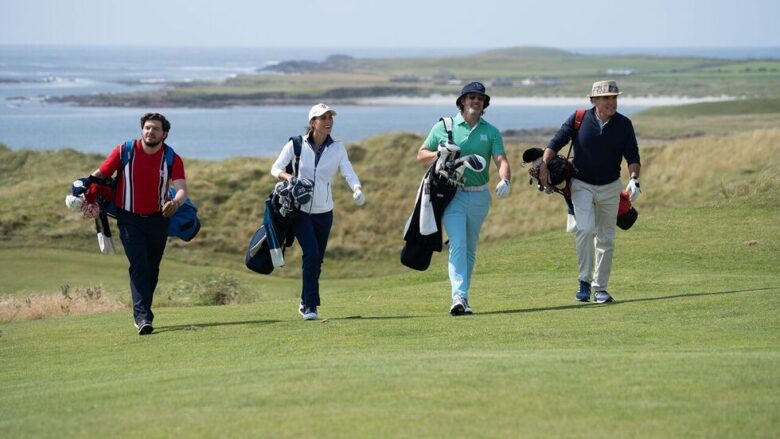
The family now has to scatter Jack’s ashes in the four locations he has chosen in Ireland (two of them are golf courses). And that’s an excuse for Freddy, who resents his da even in death; his more benign older brother, Teddy (Brian d’Arcy James), a novelist who has been suffering from writer’s block; Freddy’s musician son, Frankie (Brian Muller), whom he treats nearly as cavalierly as his father treated him; and Teddy’s adult daughter, Marie (Erica Hernandez), to take a week’s vacation in Ireland, where they’ll play out the Finnegan’s Cup at a handful of fabled golf courses, smacking around some home truths along with the ball.
There’s plenty of on-the-nose dialogue (“His dying wish was to get us all back here to Ireland”), as well as cornball boasting (“It’s not about the clubs, little brother, it’s about the man who’s swingin’ ’em”) and generic braggadocio (“I believe that is what you call an eagle!”). Freddy and Teddy never stop making side bets and busting each other’s chops, mostly about who has the better golf game, this being the locker-room form of brotherly love. If the family tension simmers, it’s mostly because Freddy and Teddy have opposite feelings about their father. Listening to their back-and-forth taunts, Marie says, “I’m sorry, so this entire trip is nothing but constant ball-busting?” Swap in “movie” for “trip,” and you’ve got an idea of “Finnegan’s Foursome,” though you should also toss in Frankie doing his cringe mock-sports-announcer banter.
“Finnegan’s Foursome” is structured as a sports movie, and Burns, working with the cinematographer Jeff Muhlstock, connects you to the geometric majesty of the links. But when you watch a film like “Tin Cup,” part of the thrill is that you want to see the Kevin Costner hero win; that’s the dramatic Zen of a sports film. Watching “Finnegan’s Foursome,” we’re not overly invested in whether Edward Burns’ entitled a-hole gets a winning golf score over his novelist brother.
There’s a touching scene where three of the characters sing “The Parting Glass” at a pub. But here’s how “Finnegan’s Foursome” is a bit soft. The movie is about Freddy coming around to see that his da really did love him, and that he wasn’t such a bad guy (he gave him the love of golf, after all). But the reason we readily buy this is that it’s so apparent from the outset. Jack’s big crime? Being away “at the office” (i.e., the golf course) too much. As ultimate sins of parents go, it’s kind of a dated sin. You want to say to Freddy, “Stop whining.” Especially because the Jack we see, in his competitive Irish way, had a lot of spirit; he was no ogre. Of course, he also tried to “get into Freddy’s head” on the golf course, but that’s kind of a privileged problem. It’s Freddy who needs to dismantle the ogre of resentment in himself, and that’s not quite a movie — that’s therapy.
The blithe and likable “The Brothers McMullen” won the Grand Jury Prize at the 1995 Sundance Film Festival and went on to have a healthy theatrical life, launching Burns’ career as a homespun auteur — at the time, he almost seemed like the shoestring Irish-American answer to Woody Allen. I was a fan of the early Burns films (especially “She’s the One,” his 1996 crossover movie, costarring Jennifer Aniston and Cameron Diaz), but his moment in the spotlight didn’t last long. After crossing over, he kind of crossed back, retreating into the not-fully-on-the-radar indie wilderness. That’s where he has remained, and watching “Finnegan’s Foursome” you see why: He’s trying to stay true to his world (all the Irish chop-busting and piss-taking), but he hasn’t grown as a filmmaker. Then again, maybe that’s not so important. He doesn’t hit long drives, but by the end of “Finnegan’s Foursome” the ball is in the cup.