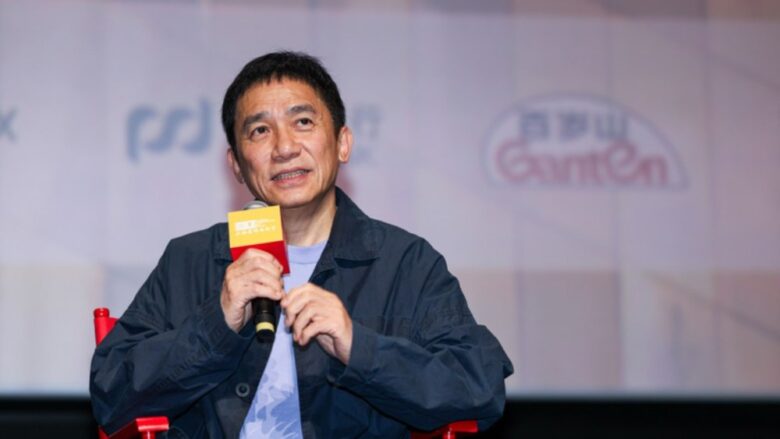
Tony Leung Chiu-wai told a full house at the Shanghai International Film Festival that his restrained performance style demands the full cinematic experience to be felt, speaking at a masterclass following a screening of his film “Silent Friend.”
“Sometimes it might just be something on my fingers, you must watch very carefully, and it must be in cinema,” Leung said.
The actor, serving as jury president of the festival’s Golden Goblet Awards competition, spoke at length about his collaboration with Hungarian writer-director Ildikó Enyedi on “Silent Friend,” which traces a relationship across three generations of scholars and a more than 200-year-old ginkgo tree. Leung admitted the script did not immediately draw him in.
“In fact, after I read the script she sent, I really wasn’t that interested in it,” he said. “The script was a three-chapter story; I could not imagine what it would be like as a film. Also, that was before the time I started to learn more about plants, so to me it was like, just plant, humans and animals’ background.”
What changed his mind was a video call with Enyedi after he had watched her previous films “On My Body and Soul” and “The Story of My Wife.” Leung said he trusted instinct over analysis when assessing potential collaborators.
“I always feel the person whom I meet rather than use my brain to analyze them, because in that way you calculate,” he said. “I felt good about her. I trusted my gut.”
Enyedi wrote the role of Professor Tony Wong with Leung specifically in mind and adjusted the central tree from another species to a ginkgo to suit him. Leung explained the choice.
“She told me the original tree was a different species; I forgot the name, but they mate with the help of bats,” he said. “The film is about loneliness. Trees only share information with their own kind but not the outsider. My character is from the east, so is the ginkgo tree. In an ancient garden in Germany, the ginkgo is lonely as well.”
To inhabit a neuroscientist, Leung spent six months reading books on plants and neurobiology and visiting laboratories to observe experiments firsthand. Around the third or fourth month, he said, the scientist’s mindset took hold without him consciously trying. He described thorough preparation as the condition for freedom on set, noting that the more prepared he was, the more shooting felt like play rather than obligation.
“Otherwise [the shooting] would become a stressful burden, no fun at all,” he said.
Leung compared the atmosphere of “Silent Friend” – a small production – favorably to Tran Anh Hung’s “Cyclo,” on which he also worked with a tight crew and room to improvise, rather than to the scale of Marvel’s “Shang-Chi and the Legend of the Ten Rings.” Of Enyedi’s working method, he said: “She left a great space for not just me but the whole crew to work freely, and she never told me how to act or where I should stand.”
Leung divided his career into three stages. Television came first; an early turning point arrived when he encountered director Hou Hsiao-hsien and was moved by the naturalism of non-professional actors in “City of Sadness.” Two decades of collaboration with Wong Kar-wai then formed the bedrock of his style. He was candid about how that long partnership could complicate subsequent work.
“At the beginning of ‘Lust, Caution,’ the costume and hairstyle made me feel like I was on set of ‘In the Mood for Love,’” he said. “So I felt something was wrong, I asked Ang Lee to give me a hint [so I could reposition myself].”
He added, with characteristic humor, that if he were to keep acting until 90 and a stage lasted 30 years, he was already in his final one. He noted that different directors bring entirely different working methods – some impose a precise vision, some grant latitude but demand rigorous preparation, while Wong Kar-wai operated experimentally, shooting a single scene many times over.
On talent and its cultivation, Leung was prompted by an audience member who held up an “Infernal Affairs” poster and cited Andy Lau’s description of him as a performer who excels even in weak films. Leung pushed back on any notion of innate, effortless ability.
“One must put effort because, even with your talent [in acting], it needs to be developed,” he said. “Liking what you do is a good start of your talent; what matters is to continue to let it grow.”
He recalled recognizing his own pull toward acting immediately upon starting out. “I immersed myself completely in it; I didn’t want to stop at all,” he said.
Asked whether he hoped to surpass his past work, Leung was philosophical. “Too many hopes usually lead to disappointment,” he said. “Better to let yourself be surprised. Have what interesting things happen, I’ll just do it.”
He said he was open to the narrowing of available roles that comes with age. “There’s nothing you can do as it happens naturally.” On father roles in particular, he quipped: “No rush. In the future there will be more dads, I don’t have that many choices left.”
Leung said his performance approach has shifted over the years toward conveying emotion through minimal physical detail rather than overt expression – a mode that only registers fully on the big screen. He said he can now absorb failure without distress, though he dislikes watching his own work back.
When an audience member posed a hypothetical choice between a flawed but distinctive film and a polished but unremarkable one, Leung said either would do, arguing that cinema’s goal was sincerity, in performance or in a director’s expression, rather than polish.
On why he has not pursued theater despite his wife, actress Carina Lau, currently working in stage productions, Leung was direct. “I lack courage,” he said. “On the stage is different from in the studio. I still feel nervous when I act in front of many people, so I’d only do it after I overcome the stress.”
Leung closed with a reflection on risk and growth, saying he had feared failure when young and had only recently begun venturing beyond his comfort zone, crediting maturity for the shift.