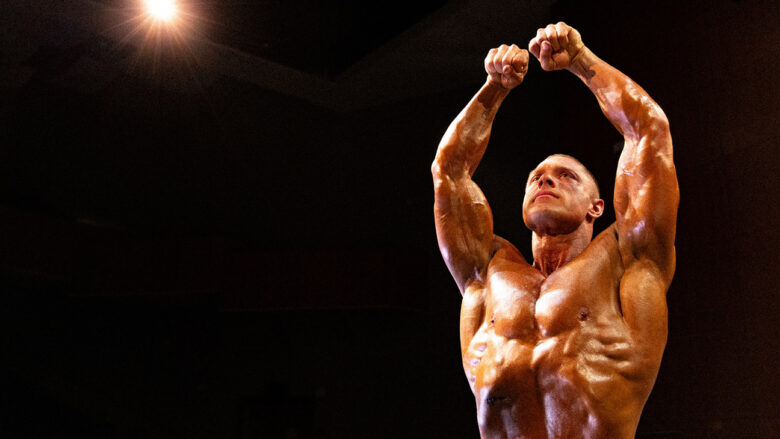
Like Elyjah Bynum’s head-turning 2023 Sundance entry, Magazine Dreams, a film whose commercial life was derailed by domestic abuse charges against star Jonathan Majors, Test is a tightly focused character study about a bodybuilder whose mental health at times appears to be hanging by a thread. What makes Sam McConnell’s film transfixing, however, is the very personal nature of the drama, written by star Brock Yurich and clearly inspired by his own story. It explores the corrosive internal conflict of a young heavyweight pushing to turn professional while struggling to reconcile his emerging sexuality with his faith and his need for independence with his suffocatingly co-dependent mother.
Unlike Magazine Dreams, the modest but satisfying Test avoids the lurid descent into violent psychodrama that swerved into hallucinatory Taxi Driver territory and undercut that film’s integrity. McConnell’s direction and Yurich’s script might occasionally be earnest to a fault, but the movie’s emotional authenticity and depth of compassion make it an affecting character study — a contemplation of hard-won queer identity that’s soulful and often saddening but judicious in its avoidance of overblown tragedy.
Test
The Bottom Line
A sensitive probe into the softness under the muscle.
Venue: Provincetown Film Festival (Narratives)
Cast: Brock Yurich, Tammy Blanchard, Mike Edward, Paloma Garcia-Lee, Evan Hall, Matthew Morrison, Heidi Lewandowski, Drew Getchy
Director: Sam McConnell
Screenwriter: Brock Yurich
1 hour 54 minutes
Eddie Owens (Yurich) lives in blue-collar Eastern Ohio with his high-strung, boozing mother Joanne (Tammy Blanchard), a holy roller who sings about the blood of the lamb while lovingly applying Eddie’s spray tan for a local competition. Joanne is more like a big sister than a mother; they goof around and make each other laugh. She’s also Eddie’s No. 1 cheerleader, his manager, coach and nutritionist, though whether any of those responsibilities are the result of specialized training or just Joanne needing to control her son is an open question.
To finance his bodybuilding pursuits, Eddie waits tables at a barbecue joint, where his co-worker Trig (Evan Hall) supplies him with performance-enhancing drugs. But Eddie also makes money through a secret life in his room at night, when he logs on at a site called “Midwest Muscle” and racks up tips as a camboy, showing off his competition-level posing skills naked before masturbating to the pinging sound of cash trickling in.
After placing a disappointing third in what should have put him one step closer to the prestigious Ohio Classic, Eddie seeks help from experienced coach Mike Reed (Mike Edward), himself a former bodybuilder. That leaves the volatile Joanne feeling shut out and bitterly resentful.
Mike drives Eddie hard in the gym and is blunt about his shortcomings, not to mention his view that Joanne is holding her son back. Telling Eddie he’s on the wrong drugs, Mike starts him on a new regimen that includes insulin, which helps build muscle fast but comes with serious health risks. There are hints of Mike’s shadowy past in his failure to account for why more than one bodybuilder abruptly stopped training with him, including his son Cody (Drew Getchy), with whom he hasn’t spoken in two years.
Aware that he can be stiff and lacking coordination in the posing part of competition events, Eddie takes it upon himself to start basic ballet lessons with his former girlfriend Abby (Paloma Garcia-Lee), who went to New York to pursue a career in dance and is back in Ohio for family reasons. That leads to renewed sexual sparks between them, though there are subtle suggestions that Eddie might just be trying to prove something to himself.
That suspicion intensifies when Mike and Eddie acknowledge their mutual desire with a kiss and start regularly hooking up. They keep it on the down low, but word soon gets around. To make things worse, Joanne walks in on one of Eddie’s online sessions and seems to believe she’s helping her son by going to Pastor Greg (Matthew Morrison), the head of their local church, for guidance.
While that does lead to Eddie being told he’s no longer welcome at the church, Yurich’s script keeps the standard manifestations of homophobia to a minimum, instead making Eddie the chief obstacle to his self-acceptance as a gay man. Abby is the least judgmental of the people in his circle, but Eddie pushes her away, compounding his isolation. When Cody resurfaces, Mike, too, becomes distant.
McConnell gets solid performances from his actors, none more so than Yurich, who obviously took a leap by entrusting his story to someone else but pours himself into the role to a degree that suggests complete trust. Eddie is a hard-bodied hulk, but his insecurities are crippling, which makes Abby’s caring words ring true when she confesses that she sees him as “a little boy who’s really fucking scared.”
There’s tenderness in the story’s example that masculinity and vulnerability are not mutually exclusive. It’s the rare extreme sports movie with a fragile heart.
Yurich traces Eddie’s spiraling loss of control and his lurch into self-harm with raw feeling, and both writer and director take risks with a final act that can be interpreted as a victory but never glosses over the tremendous physical and emotional cost. Test is somewhat open-ended; the hope that Eddie will grow comfortable with who he is and live more freely is tempered by lingering melancholy.
By turns sexy, tough and despairing, this is an astutely observed, compelling film about masculinity, about the collision of sexual desire with religious belief, about muscle mass as armor — a shell to hide in. That latter aspect is intensified by the shift in DP Ava Benjamin Shorr’s visuals, from the washed-out shades of Eddie’s environment to the glistening golden form he displays on an otherwise darkened stage.
In one beautiful sequence showing the movement routine of a competition set to “The Swan” from Saint-Saëns’ Carnival of the Animals, Eddie incorporates the physical grace Abby taught him in her family’s dance studio. Grace ultimately is what the movie bestows on its messed-up protagonist, without erasing his pain or resorting to cliché.