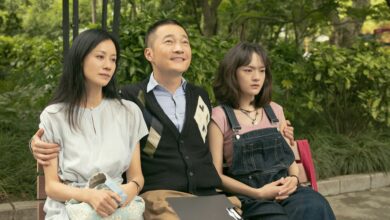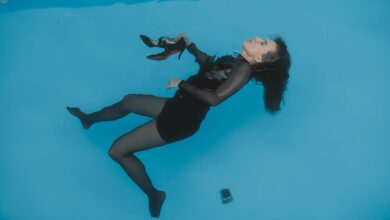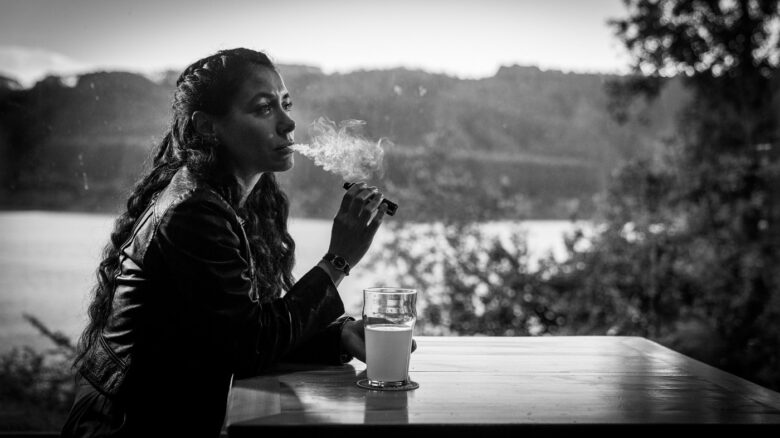
Sofía has just finished her psychology studies in Valparaíso, Chile, and returns to her hometown, Valdivia. This return coincides with the discovery of a young girl’s body, which awakens buried memories of childhood in Sofía. She must decide whether to look beyond the rain and its veil to uncover a past that is painful and uncomfortable not only for herself but also for her whole community.
Director Valeria Sarmiento’s new film Behind the Rain world premiered in the Crystal Globe main competition of the 60th edition of the Karlovy Vary International Film Festival. Mixing beautiful black-and-white landscape images with the difficult subject matter of childhood sexual abuse, the movie is based on an original idea from Sarmiento and a screenplay that she worked on with the late Omar Saavedra Santis. The director of photography is Acácio de Almeida; the editor is Galut Alarcón.
The cast features Paula Prado, Cristián Arriagada, Aline Kuppenheim, Shlomit Baytelman, Chamila Rodríguez, Daniel Muñoz, Julio Milostich, Aimar Alarcón Rodríguez and Clara Vargas Arellano. Rodríguez is also the producer of the movie.
Sarmiento and Rodríguez, who have been collaborators since Secrets (2008), talked to THR, via an interpreter, about Behind the Rain and their hopes for the societal debate it could cause.
What inspired this story and led you to make a film about a very important, and also very heavy, topic?
Valeria Sarmiento The initial inspiration was that in our society, child abuse is sadly really common. And oftentimes, we are silent about it.
‘Behind the Rain,’ courtesy of KVIFF
You worked on the screenplay with Omar Saavedra Santis. Was that his final film project, and how did he come on board?
Sarmiento Initially, I wanted to work on the film with my French and Swiss friends, but we did not really make any progress. When I met with Chamila, she suggested to go back to where it all started, which meant Chile. And that’s when I contacted Omar, who then he joined the team and developed my initial idea further.
Chamila, why did you want to work on this film – both as an actress and producer?
Chamila Rodríguez I was really intrigued by the artistic complexity, and I’ve been working with Valeria for 20 years. So, I had great trust in her. While we were working on our previous film, she started talking about this story, and it was very appealing to me, because I experienced something similar when I was a child. My experience of child abuse was hidden, and I never spoke about it until I was 40. Then; I finally started to speak about it, so I could really relate to the story. When she showed me the script, I immediately knew that I wanted to do it. I also see art, including film, as a way to exorcize demons, as a way to transform horrible things into something that’s more positive.
Your character isn’t necessarily the easiest person to be around…
Rodríguez Yes, my character is a lawyer who is really difficult to be with.
Behind the Rain has stunning black-and-white visuals, with color coming in only at the very end. Can you maybe talk about that choice?
Sarmiento I knew from the very beginning that the film was going to be in black and white, except for the ending, because I grew up seeing films with no color. I was born in 1948, so it took quite a time before I was able to see a color film. And the title also comes in here. My mother said to me that I have to look behind the rain in order to see all the colors and aspects, so that’s what I tried to do.

‘Behind the Rain,’ courtesy of KVIFF
How did you cast Paula Prado in the lead role?
Sarmiento It was not easy to find an actress who would be able to travel with us to Valdivia, because many actresses work in theaters, and they can’t really travel to go there. And when I found Paula, I immediately felt that she was the right person, that she would be the perfect one to convey the ideas of the film.
How was the whole experience on set?
Sarmiento The shoot was very harmonious.
Rodríguez It was. And it is a great pleasure to work with Valeria, because as a director, she’s really calm, and you can trust her. You feel safe, and she knows exactly what she wants. Also, Valdivia is a beautiful small town. Everything is close there, so from a technical point of view, it was really helpful and easy to work there.
What is your hope for the film and the discussions it can maybe create in society?
Sarmiento We hope the film will do exactly that.
Rodríguez Yes, because people have to talk about it. It’s like the abuse is hidden because children don’t have the words to be able to tell others about what’s been happening