Ask your average TV critic to list their favorite Netflix originals and you’ll get a lot of BoJack Horseman and Orange Is the New Black, plus some votes for The Queen’s Gambit or Adolescence from limited series fans, Dark from twisty sci-fans, and maybe some Squid Game or Stranger Things love from folks who never finished either series.
There’s a small subset of open-minded viewers, though, who would find some way to mention Rachel Shukert’s adaptation of The Baby-Sitters Club. It lacked overt prestige and, based on its abrupt cancellation after two seasons, apparently lacked wide viewership, but more than anything it suffered from the perceived stigma of being for and about young women and therefore somehow unworthy of celebration.
Little House on the Prairie
The Bottom Line
Heart-filled and honorable.
Airdate: Thursday, July 9 (Netflix)
Cast: Alice Halsey, Luke Bracey, Crosby Fitzgerald, Skywalker Hughes, Jocko Sims, Warren Christie, Wren Zhawenim Gotts, Barrett Doss
Creator: Rebecca Sonnenshine
The truth is that The Baby-Sitters Club, while for and about young women, was an almost flawless example of a series that aimed at a target and hit that target dead in the center. It was earnest and wholesome and warm and likable and perfectly cast, and even if it wasn’t directed at me…I’m a grown-up capable of appreciating things of quality made for other people.
Rebecca Sonnenshine’s adaptation of Laura Ingalls Wilder’s timeless Little House on the Prairie series isn’t as fully realized as The Baby-Sitters Club, but the things that the eight-episode first season accomplishes are similar. It’s an honorable interpretation that’s accommodating of Wilder’s books and their spirit, sincere in purpose and respectful in execution.
These days, I’m far from the target demographic for Little House on the Prairie, but I found myself emotionally involved in the proficiently old-fashioned storytelling and rather wonderful ensemble, anchored by relative newcomers Alice Halsey and Skywalker Hughes and more established veterans Luke Bracey and Crosby Fitzgerald. Though the series has laggy spots at midseason, and there are elements that a show tailored specifically for me would have approached with an extra layer of nuance, Little House on the Prairie nails its key moments and finds a way to carve a place outside the shadow of the beloved ’70s and ’80s version.
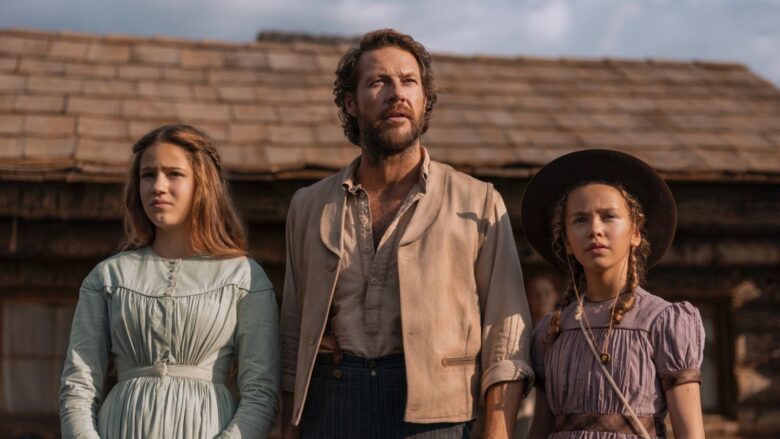
We meet the Ingalls family as they make their way from the Big Woods of Wisconsin to the newly established town of Independence in Kansas. Young Laura (Halsey) is an enthusiastic storyteller and slingshot-wielding tomboy, apple of Pa’s (Bracey’s Charles) eye. Her older sister Mary (Hughes) is a passionate reader, lover of fine ribbons and is just beginning to notice boys. Ma (Fitzgerald’s Caroline), a teacher in their old life, is strong and determined, hiding a new pregnancy out of concerns about inhospitable terrain and the uncertainty of medical assistance. Their dog, Jack, is a good dog.
Independence doesn’t have a post office or a church yet, but railroad man Eli (Michael Hough) and busybody wife Jemma (Mary Holland) have big plans for the town, and welcome the Ingalls clan with open arms.
The community includes kindly doctor George Tann (Jocko Sims), generous store owner Emily Henderson (Barrett Doss) and gruff, whiskey-loving hermit John Edwards (Warren Christie). Everybody in Independence is eying a new life and new opportunities, while facing the adversity of the frontier.
A lot of said adversity will be familiar in either specifics or generalities to readers of Wilder’s semi-autobiographical works: economic hardship, unpredictable winters, wolves, fevers. Some elements have been expanded or embellished for the show, including Pa’s discovery that the land he was told was open for settlement was actually owned by the local Osage tribes, who aren’t happy with the encroachment, much less the deal offered by the government for property they’d occupied for generations.
It’s here that I must warn you that the worst people you know are probably going to complain that Little House on the Prairie is “woke.” This complaint will be based on the idea that the Black doctor featured briefly in previous versions of the tale now has a more dimensionalized character, with a love interest and backstory, and that the region’s indigenous population now has representative characters who articulate the discomfort of being forced off their land in the name of Manifest Destiny. Laura makes friends with an Osage peer (Wren Zhawenim Gotts’ Good Eagle), whose parents (Meegwun Fairbrother’s Mitchell and Alyssa Wapanatâhk’s White Sun) are featured and allowed to articulate their thoughts as well.
And I guess if that makes Little House on the Prairie “woke,” so be it, though I’d note that the Ingalls remain the undisputed heroes of the series and they remain fundamentally decent and empathetic people. Actually, most of the series’ settler characters are fundamentally decent and empathetic — and Christian — people, recognizing the irony of living in a town called Independence when their very existence depends on family and community. This, incidentally, is thoroughly the theme of Wilder’s books as well. Sonnenshine and her team of writers and directors — all women, starting with Sarah Adina Smith and concluding with Reservation Dogs veteran Sydney Freeland — are just expanding the world and bringing it to life in a way that doesn’t deny its basic truths.
Really, though, I know that Little House on the Prairie isn’t woke, because if the series were being made specifically for me, it would spend even more time with the Osage and more time on the realities of being a Black doctor and a Black store owner in the post-Civil-War frontier. But this is not that series.
This is not the gritty or ultra-realistic take on Little House on the Prairie. Laura and Mary’s greatest joy is still peppermint sticks; they still believe in Santa Claus, or at least in the idyllic perfection of Christmas; tragedies and misadventures are still around every bend, but warm-fuzzies are every bit as plentiful.
The series’ primary visual language is dominated by impeccably photographed sunsets and sunrises, by rays of light broken up by amber waves of grain, by images that are taken straight from the pages of books I haven’t read in 40 years — jars of hard candy, Ma’s porcelain doll over the nightstand, stealing a loaf of cornbread fresh from the oven — that immediately sprung to mind as I watched. It’s beautifully shot, primarily in Winnipeg, perfectly accompanied by Dan Romer’s score, and somehow it jerks tears aplenty, happy and sad, without ever feeling overbearing or mawkish.
Much of the show’s success is attributable to casting directors Rachel Tenner and Rick Messina and a young cast that walks the line right up to precocity without ever sacrificing what has always made these characters so endearingly imperfect. Halsey is remarkable, broadly expressive in a way that allows for Laura to be plucky yet vulnerable, openly youthful yet wise, instantly relatable in her insecurities, her brattiness and her everyday pluck. She’s balanced by Hughes, who projects as slightly more modern in affect but remains believably on the cusp between childlike and mature, which lends sweetness to her flirtations with Kowen Cadorath’s Caleb, an orphaned shop-boy. Laura and Mary’s sisterly bond and bickering is convincingly captured by the two leads, with Gotts providing a good complement in her scenes with the Ingalls girls.
Is Bracey, whom I vaguely recall from his brief star-making moment in G.I. Joe: Retaliation, Michael Landon? No, he is not. But he projects the necessary earthy nobility and melts in his scenes with Halsey (even if I wish Netflix hadn’t originally described Pa as a “girl dad,” since it implies an anachronistic spirit the show doesn’t possess). Fitzgerald, who has the tougher part and plays it well, and Bracey have the requisite chemistry to embody characters who have chosen discomfort and a life together over simpler and safer options.
Christie’s soulful torment, Doss’ bright-eyed spunk and Holland’s meddlesome prissiness all stand out, as does the presence of Shoresy favorite Maclean “Jory Jordan” Fish as a young settler named, confusion-be-damned, Adam Scott.
Over eight episodes, most running under 50 minutes but never dull even in the longer installments, Little House on the Prairie captures a tumultuous year in the life of the Ingalls family, a year with danger, romance, heroism and the learning of many important lessons. I don’t gravitate toward “wholesome” or “earnest” as attributes in most of my favorite shows, but I bought into Little House on the Prairie and I’m relieved that Netflix has already renewed it for a second season.
Hopefully, people won’t kick up too much of a fuss about small changes to the text and will embrace its admirable intent. I don’t want a repeat of The Baby-Sitters Club and its premature cancellation.