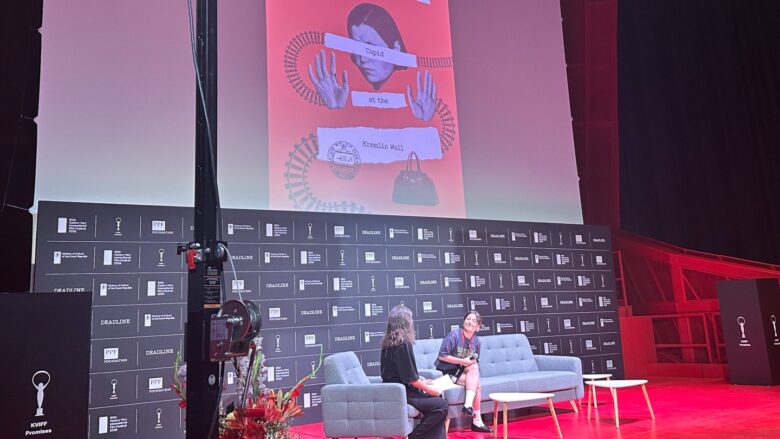
Bookworms and others came together at the expanded and broadened KVIFF Industry Days program of the 60th edition of the Karlovy Vary International Film Festival (KVIFF) on Tuesday for the inaugural Book-to-Screen at KVIFF showcase.
It featured a selection of literary works from Central and Europe deemed suitable for film or TV adaptations. “Our long-term ambition with Book-to-Screen at KVIFF is to become a true Central-Eastern European IP market that helps develop dialogue between the film and publishing industries and create a more transparent environment for adaptation rights in the region,” said Hugo Rosák, the head of KVIFF Film Industry Programs.
All in all, eight original literary IPs took the spotlight in the Czech spa town’s Imperial Spa, which mixes traditional and modern architecture, similar to how the books in focus cover the past, present and future. Here’s THR‘s closer look at the book pitches for potential screen adaptations.
Cupid at the Kremlin Wall (Georgia)
Author: Aka Morchiladze
Genre: historical drama, detective novel
Publisher: Sulakauri Publishing
Synopsis: “The historical drama Cupid at the Kremlin Wall takes place during a tragic train journey across Georgia, at the height of the Stalinist terror in the 1930s. Historian Aka Morchiladze, its author, is an accomplished writer who has over 30 novels published in 15 countries. He has written several screenplays, and his previous book Journey to Karabakh was adapted into a film.”
Pitch highlights: Publisher Nuka Gambashidze described the protagonist, a former revolutionary who is owning up to past mistakes, as “a woman of action who is stubborn.” She is also restless, even though she is trying to stay undercover. Fiction and historical reality intertwine as real-life characters show up in the novel, including such filmmakers as Sergei Eisenstein and Raisa Vasilyeva. “It really shows the effect the Great Purge had on filmmakers,” the publisher explained. Stalin also features, and “he is shown in two different lights,” she teased.
Playing Wolf (Czech Republic)
Author: Zuzana Ríhová
Genre: folk horror, psychological thriller
Publisher: Argo
Synopsis: Playing Wolf is “a village novel you want to read in the safety of the city,” KVIFF says. “This folk-horror thriller by writer and literary scholar Zuzana Ríhová, former head of Czech Studies at Oxford, was successfully published in France and the USA by Éditions du Seuil and Catapult, respectively.”
Pitch highlights: A couple moves from the city to a place in nature. One key character gets filmed with mobile phones while she is dressed up as Little Red Riding Hood, the pitching session revealed. “They come to a remote place in nature, but things just go down from there,” said publisher Gabriela Kiszová.
The River Odyssey of Kora from Willow Meadow (Poland)
Author: Adam Robiński
Genre: children’s literature
Publisher: Widnokrąg
Synopsis: “A representative of children’s literature, the Polish title The River Odyssey of Kora From Willow Meadow by Adam Robiński tells the story of a young beaver named Kora with ecological relevance.”
Pitch highlights: “This is a coming-of-age story and an unexpected formative journey of personal growth,” publisher Anna Nowacka-Devillard explained, highlighting such themes as courage and resilience. “At the end of it, she is no longer the same young beaver she was at the beginning.” And she argued that there are “echoes of Frodo” Baggins in this “universal” story. There is no human in the book beyond one young boy, signaling how the story cherishes nature.
Queen of Hearts (Moldova)
Author: Iulian Ciocan
Genre: dystopian novel
Publisher: Polirom
Synopsis: “Queen of Hearts, a dystopian satire by Moldovan author Iulian Ciocan, explores an ever-expanding, all-consuming crater in the middle of post-communist Chișinău, Moldova.”
Pitch highlights: A corrupt politician … who is very happy to be pocketing money,” explained literary agent Livia Stoia. “He built up his whole life on bribes,” until he hurts his ankle when stepping into a hole. As a result, he experiences nightmares that the capital city Chișinău that he lives in will be swallowed by it. “He decides to go to a fortune teller, who tells him to find The Queen of Hearts to get redemption,” she explained. “Otherwise, this hole will swallow the whole capital.” Calling the book a “hilarious post-Communist satire,” the publisher warned the audience not to expect a happy ending, though.
Aspic Bistro (Lithuania)
Author: Ieva Dumbrytė
Genre: magic-realism satire
Publisher: Kitos knygos
Synopsis: “Aspic Bistro by Ieva Dumbrytė, set in a surreal, almost Orwellian-controlled kitchen environment, won several awards in her native Lithuania, including the prize for the Most Creative Book of the Year.”
Pitch highlights: The protagonist is a history student who becomes the first university graduate in his family, film rights agent Benas Bèrantas told KVIFF. But he has no “proper job, so he feels like a failure,” just like his parents do, he explained. “It’s a very harsh and almost-Orwellian kitchen,” he said, mentioning that “survival matters more than comfort.” But a woman brings “a glimpse of hope” to his life, until she may turn into a pig. The tone was, not surprisingly, described with such words as “absurd” and “dark humor.” Bèrantas’ closing pitch: “It’s like the film Delicatessen in an Eastern European kitchen.”
The True Way Out (Czech Republic)
Author: Patrik Banga
Genre: coming-of-age, autobiography
Publisher: Host
“True Way Out, journalist Patrik Banga’s memoir about growing up in a Roma community in Prague’s Zižkov neighborhood in the 1990s, won the Magnesia Litera award for best debut in 2023.”
Pitch highlights: Publisher Michaela Dermauw highlighted such themes as poverty, racism, rejection and police brutality that the book explores. The story reflects the author’s childhood experiences, she explained. But it’s not all dark and pessimistic. After all, “he is also describing the way out of this misery,” she said. “This is an incredible story of a man who never gave up. … It gives you hope. … And it’s full of music.”
The Zone (Slovakia)
Author: Daniel Majling
Genre: graphic novel
Publisher: Brak
Synopsis: In this graphic novel by the author and playwright, “a mysteriously hostile space takes on the title role itself. Absurd characters, dark humor, striking visuals, and cult status among Central European comics fans (the novel received the Czech Muriel Prize) all contribute to its strong adaptation potential.”
Pitch highlights: Where is the story in the post-communist era set? “In the poorest part of Slovakia,” said publisher František Malík, explaining that there are people with “anti-superpowers.” For example?! “Depression is inheritable. And some people can kill you just by talking.” The protagonist is “a oser comic writer and artist who lives by himself and has only one friend who disappears.” So, he goes looking for him. How does Malík describe the protagonist? “He is absurd and melancholic. I might call him the Slovak Woody Allen – but from the better first half of his career.”
Amadoka (Ukraine)
Author: Sophia Andrukhovych
Genre: historical/war novel
Publisher: The Old Lion Publishing House
Synopsis: The war in the Donbas serves as the starting point in Amadoka, “a novel that combines an intimate human story with the vast historical trauma of Eastern Europe in a deeply cinematic way.” Writer Sophia Andrukhovych won the International Hermann Hesse Prize 2024 for it. Her debut novel Felix Austria won the BBC Ukrainian Book of the Year award and was adapted into a film titled Devoted.
Pitch highlights: “Amadoka is one of the key metaphors, and it symbolizes erased memory, hidden or lost identity, and lost generations,” said publisher Ivan Fedechko. The book addresses Stalin’s repression, famine, the Holocaust and the ongoing Russian war in Ukraine, among other defining traumas of Ukrainian history. But it also explores other themes, said Fedechko: “This is also a novel about love and about how powerful and redemptive it can be, but also how dangerous and destructive.”