
Olivia Wilde wants to start conversations. Her latest film, the sex comedy of manners “The Invite,” asks more questions than it answers, prompting audiences to look at their own lives and relationships with a more honest gaze.
Written by Will McCormack and Rashida Jones, the film is an adaptation of the Spanish film “The People Upstairs” by Cesc Gay that stars Wilde as a stay-at-home wife mother named Angela whose marriage to her husband Joe (Seth Rogen) a one-time punk singer turned burnt out music teacher, is on the rocks. Things get shakier when Angela impulsively invites the beguiling couple upstairs, Pína (Penélope Cruz) and Hawk (Edward Norton), for a lively dinner party. Things quickly unravel as hidden desires, unspoken fears, and other complexities surface.
Born in New York City and raised in the Georgetown neighborhood of Washington, D.C., Wilde was the child of British journalist Andrew Cockburn and journalist and “60 Minutes” producer Leslie Cockburn. Before stepping behind the camera, Wilde broke out as an actress in popular TV shows in the mid-2000s, like “The O.C.,” where she played bisexual bar owner Alex Kelly, and “House,” where she played Remy “Thirteen” Hadley opposite Hugh Laurie.
She also acted in blockbuster films like “Tron: Legacy,” awards contenders like Ron Howard’s “Rush,” and indie films like Joe Swanberg’s “Drinking Buddies” and Reed Morano’s “Meadowland.” Wilde’s feature film directorial debut, “Booksmart,” won the Independent Spirit Award for Best First Feature, while her second feature, “Don’t Worry Darling,” debuted at the 79th Venice International Film Festival, and her latest feature, “The Invite,” premiered at the Sundance Film Festival in January.
The same day a 35mm print of “The Invite” opened the Chicago Critics Film Festival in May, RogerEbert.com spoke with Wilde about taking inspiration from Sidney Lumet and Mike Nichols, recreating an entire vintage San Francisco apartment on a set, the influence of Esther Perel’s philosophy, the precarious place women inhabit in the film industry, and why she hopes her film will inspire arguments.
This interview has been edited for clarity.
Your film starts with a cheeky quote from Oscar Wilde, who also inspired your stage name. Was part of the script, or was that something you brought to it?
That was not part of the script. I added that because I’m a big fan of contextualizing for the audience from the filmmaker’s perspective, in a way that allows for some specificity of the lens. So you understand what you’re heading into. Also, for me, that quote perfectly captures the film’s dichotomy, where we have a romantic spirit mixed with a load of cynicism. The film certainly contains both of those things. It felt right to me. I added it at a certain point in the edit, and I didn’t know if I was going to keep it in there. I really had it in there for myself as a north star to define my feelings about the film, and to make myself laugh, because that quote makes me laugh.
The pace at which the second half of the quote comes in. It always makes me giggle because the audience, at first, sees the first part, which says “One should always be in love,” and they think, okay, that’s a very sentimental way to begin this movie. And then the second half comes in, “That’s the reason why one should never marry,” and before the Oscar Wilde name comes in, I can feel people going like, “is that… that feels…” and then Wilde comes in, they’re like, “That’s right, that’s what we thought.” So it just seems to frame the experience in a way I’m a fan of. Filmmakers before me have used that device. It’s been used by Woody Allen to great effect, and it felt right for this film.
The film is reminiscent of Allen’s “September”; it’s mostly set in one space, there’s a party, and couples are falling apart.
Well, there was this really fun one-location film festival we held for ourselves in prep for this film, where we studied films that showed how filmmakers had taken on the challenge of a limited environment. “12 Angry Men” was another one that really influenced us. I think Sidney Lumet’s book, Making Movies, has a really great section on how he used cinematography to make you feel the crushing claustrophobia of that room, and then the shifting perspectives allow for a complete change in the visual storytelling. It’s masterful.
“Who’s Afraid of Virginia Woolf?” was my number one. I mean, Mike Nichols, in general, is my number one, and I think that “Virginia Woolf” is a master class in emotional storytelling through the camera, and to feel that, though you’ve been in one space, you’ve almost been watching an emotional action film that’s taken you to several different locations, but you realize it’s all been within the emotional turmoil of these people. I love the explanation of his approach to cinematography, which is actually in the Mike Nichols biography by Mark Harris, about how Haskell Wexler tied a rope to the actor to the operating camera and swung them around, which is probably one of the most innovative and inspiring cinematography moves that I could imagine. We didn’t get to do that exact move, but I thought, well, of course, the camera is allowing us to get drunker with those characters and get more angry and more out of control. It’s another master class. We were inspired by so many of these films.
The way you frame the characters in space, sometimes you have them really wide in the room, and you feel the division, and then other times you get really close. When you were thinking of those shots, were you someone who storyboards?
My cinematographer, Adam Newport-Berra, who’s really creative and deeply passionate, we knew, because I was going to be in the film, that prep was really our chance to develop this shared mindset about the goals for visual storytelling. Instead of drawing through storyboarding or a specific shot list, we had a series of inspiration shots from films we loved, from Agnès Varda’s “Le Bonheur” to “Hannah and Her Sisters” to, certainly, “Who’s Afraid of Virginia Woolf?” We looked to those inspiring images as suggestions that we would remember in the moment, without being overly prescriptive.
The use of wide shots versus extreme close-ups was heavily influenced by both Lumet and Mike Nichols. The idea that the audience would feel at times intrinsically connected to one character’s emotional crisis and at other times, like more of a voyeur, it takes advantage of the medium in a way that you feel inspired to do when I think you’re doing a movie based on a play, because you’re asking yourself the whole time, “Why is this a film and not just a play?” And the answer is, because this film allows us, the medium allows us, to really become the characters and to get so close to them that we feel the slightest twitch.
I love asking that question, “Why is this a movie?” I think with any project, it’s worth asking, “Why isn’t this just a novel? Why isn’t this just a play? Why is it a movie?” And it’s like, you better be using these tools to communicate differently. Obviously, Bergman was also a huge influence with “Scenes From A Marriage.” So Adam and Jade Healy, our production designer, had such a good time trying to figure out how to make this limited space feel like an additional character that was, of course, reflecting how the relationship was evolving, shooting through glass, shooting around corners, using mirrors.
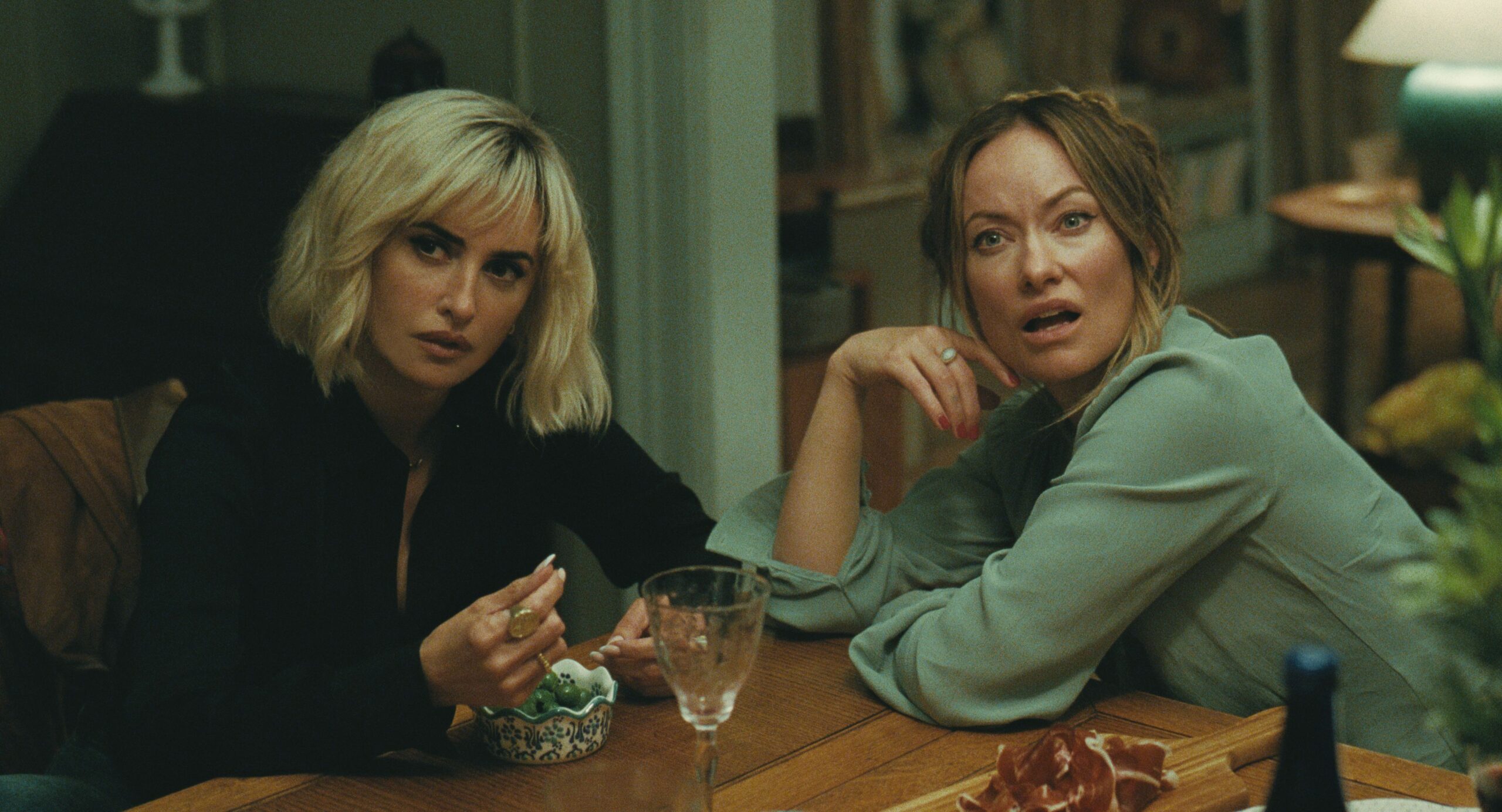
I love it when a filmmaker uses mirrors to show the doubling of a character, what they’re presenting, what they’re hiding, and the mirror shows you both at the same time. At what point in the production were you thinking about using mirrors that way?
Pretty early on, we were thinking of how we can specifically show Joe and Angela sharing space while being in completely different spaces emotionally. So mirrors were a helpful way to show the two of us in the same frame without us traditionally sharing the same space, and that inspired us to find different ways to use them. It also allowed a relatively simple space to feel more graphic in its visual language. I think that mirrors allow for layering, and the layering felt right for this story.
We had such a good time figuring out the palette of this apartment. Ariane Phillips, our costume designer, came up with the idea that Angela’s shirt should match the wall color because she’s completely sacrificed her identity and is blending into this home that’s become her entire purpose in life. All of those choices were made in the prep process… that was the most potent prep I’ve experienced. We weren’t doing you a huge amount of scouting, so the process was boiled down to something unlimited, which allowed for this condensed experience within that space and within the story. I hope to have another experience as interesting as this one. It was so fun.
The apartment felt very San Francisco to me.
When we scouted in San Francisco, we looked at several apartments, then recreated them. I’m really grateful we were able to build our set because we were able to control the space in order to allow for a lot of the visual language we were dreaming of, including the kind of air shaft interior for the windows to be able to face each other, and that was entirely inspired by apartments we’d seen during the scouting.
Also, Jade was so sensitive about authenticity that these characters had to feel like they were from there, and the apartment was responsible for this whole other level of storytelling. It had to be the place where Joe’s character had grown up, so it had to feel a little bit out of their price range. It had to have history. We had a lot of fun with the sound design and adding the creeks to the floor, and all those layers were fun to build.
But I’m really grateful that [screenwriters] Rashida Jones and Will McCormack specified San Francisco as the location, because it limited our choices in a great way. Sometimes you get a script that’s very vague in terms of where it’s placed, and it’s harder to immediately see who these people are and where they’re from. So I loved that they had made that decision, and we worked from that decision, and it felt very right.
One of the character beats I loved is at the beginning, when your character is making the soufflé and pulls out an old copy of The Joy of Cooking. I wondered where that came from.
Yes! I think we all had that cookbook in our kitchen. We all feel so emotional about that cookbook, and it is something you sense was handed down and had the weight of it, and the stains on the pages, they’re made of onion paper thin. It felt like it told a different story than if Angela had a brand-new, glossy Ina Garten cookbook. There’s something about having this thing that represented tradition in keeping with her philosophy of renovation without change. She’s trying to reach for something traditional, but not really able to achieve it.
All three of your films explore dynamics and relationships in flux. In “Booksmart,” you have these girls who are growing up and growing apart, but they don’t want to. In “Don’t Worry Darling,” there’s a lot of growing apart happening with those characters, and then this one, they’re growing apart. Although maybe they’ll come back together. You don’t know.
Well, all three films are about a combustion point happening for different reasons and different relationships. Someone said something to me the other day that I can’t stop thinking about. He said, “I think I figured out what you make movies about. I think you tell stories about people coming to the realization that intelligence isn’t enough.”
I was blown away by this, because I hadn’t ever thought about it from that perspective, but now I’m obsessing over this, because I think it’s interesting that each movie is about someone who gets to the limits of logic and has to go beyond that into unknown territory that can at times be really intimidating, terrifying, and emotionally very vulnerable.
I think that is actually what happens in relationships. You get to a point where you have to exit your logic brain and tap into something deeply human and emotional, and to trust your instincts, and to leap into that void, and it is not guaranteed, it’s not safe, and it’s actually the most valuable thing you can do for yourself. It often happens, I think, when you get to a point of maturity, when you realize you’re ready for that leap.
I do think these points of combustion in relationships are really interesting. There’s always an inflection, a change that has to happen, and maybe it’s evolution. As in “Booksmart,” they’ve gotten to the point where it’s time to see themselves as individuals. In “Don’t Worry Darling,” it’s about betrayal. In “The Invite,” it’s about the point of realizing they can no longer blame their unhappiness on each other, and are they willing to start a new relationship with each other, or is it time to part? What I hope people take away is the Esther Perel philosophy that runs throughout this film.
She was a consultant on the film, so it is certainly intentional. That is, questioning yourself honestly within a relationship. Are you ready to take responsibility for your own happiness? Are you able to maintain your individuality while connected to another person? You may not blame your misery on your partner; it’s your own choice, and this relationship might be over, or it might be something to be reinvented within the union. I really hope people leave the theater and consider the conversations they may not have had.
Obviously, our ending was another Mike Nichols reference. Everyone is always aiming for the ending of “The Graduate” in terms of ambiguity. We all so admired that choice. I want people to make their own decision at the end of this film, but I am fascinated by how evenly split the audiences have been so far. It’s been 50/50. We did a poll in Boston, and the audience was literally 50/50. It was so cool. It was exactly like on set. Seth and I completely disagree on what happens at the end.
I love that people are responding in this way. It’s a Rorschach test. They’re projecting themselves all over it and making these decisions, and there’s nothing you can ask for as a filmmaker that’s more exciting than people continuing to talk about the film afterward, which we’ve been lucky enough to observe at all these screens. I love it. We drive away, and everyone’s out in front of the theater arguing. My dream is that this summer, people will go see this with their friends, partners, or strangers, and then go and, like, break bread together afterward and argue.
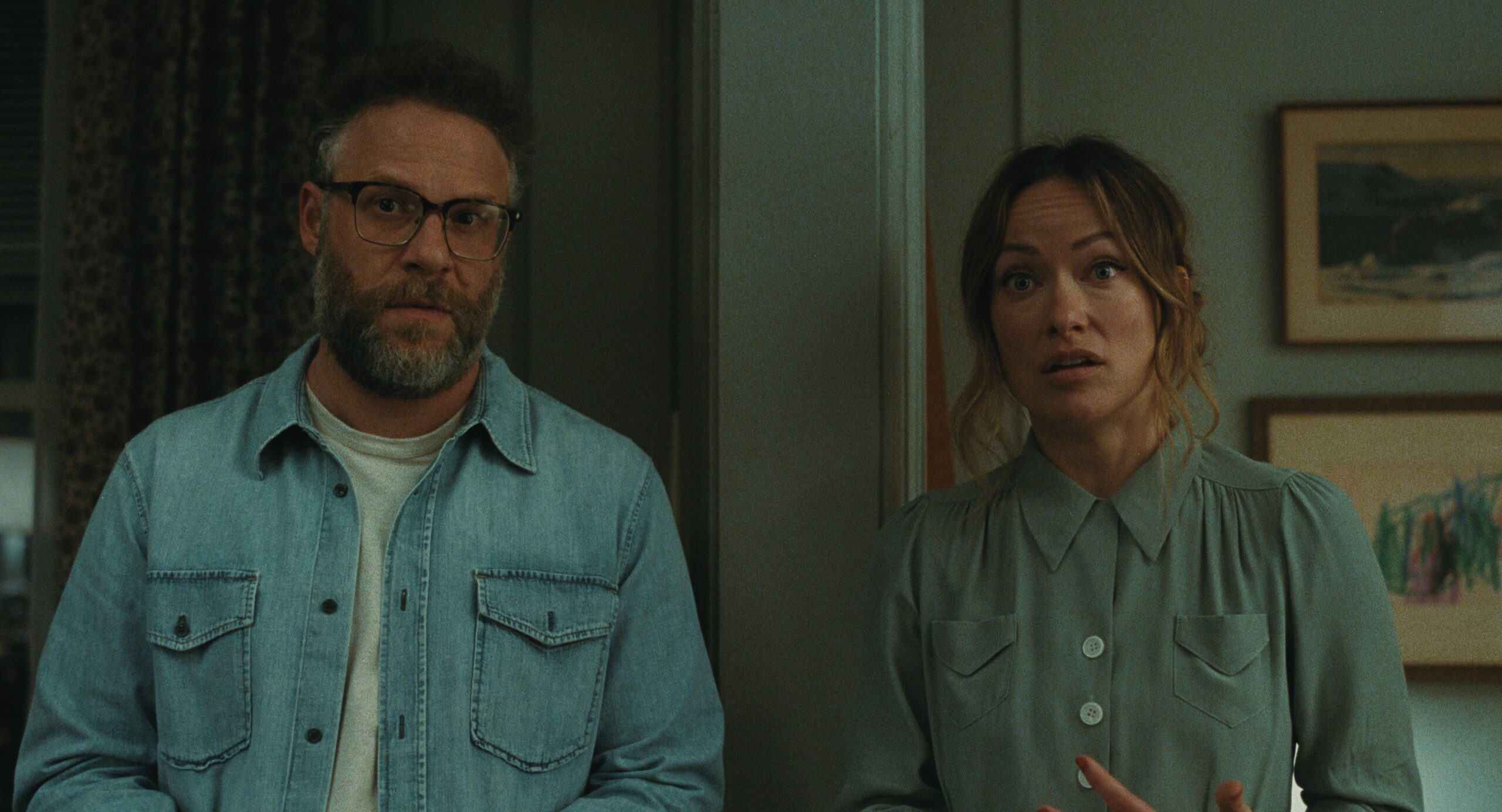
It really speaks to whether you’re a half glass full or half glass empty kind of person, because just because you’re playing the same old song, one last time, but it could be one last time, or could be for the first time, right?
Yes! Or with a renewed appreciation. Also, I’m really excited because the song played during the credits is the demo of “Our House” sung by Graham Nash and Joni Mitchell. It’s the first time they’ve licensed it for a film. The reason it moves me so deeply is that, if you know anything about that song, if you know anything about Graham Nash and Joni Mitchell, you might know that they were in love and that song was their song, and then they broke up. I fought so hard to get that song because I think there is this sense of wanting people to be together, because we like the idea of staying together, but we need to find the acceptance that sometimes a story is over, and it’s fucking heartbreaking.
The way Seth Rogen’s character wrote about yours is great. You don’t hear it, but it doesn’t feel like he’s just upset that his music career didn’t work out; obviously, the inspiration was Angela, and that relationship is in flux. It’s fascinating what happens when the inspiration behind a love song is gone.
Yes! I think the hardest thing about getting older and having more and more relationships is losing a little bit of the fantasy you may have begun with. There is this optimism that I think evolves from that, that allows you to see that even when it doesn’t work, it was worth it. It’s the worst thing someone tells you when you’re going through a breakup. It’s the last thing you want to hear, that this is the best thing that’ll ever have happened to you, I swear, you’re so grateful for this horrible pain.
Certainly, when people are splitting up, when there are kids in the picture, and it’s deeply painful for everyone, there comes this moment when you understand that the peace that results from separation is so much better than the agony of contempt that sometimes weasels its way into a relationship. I think once you experience contempt, it’s very hard to undo that. Loss of respect is hard to undo. I think for these characters, I believe that they are on the edge of contempt, and that Penélope Cruz’s character is drawing their attention to that, and saying that this is a losing game. Contempt is no place to raise a child, and you gotta call it, but you have a chance to begin again.
It’s so sweet. Seth is such a softy, and he’s like, “I think they stay together. I think they’re together forever.” And I was like, “Oh, sweet Seth.” I felt like they broke up, but they have this newfound respect for one another and will be best friends. But they each have so much life to live. I believe he’ll go back to playing music, I think she’ll go back to school, or she’ll start doing more photography. I have a whole theory.
I love that it’s a film that doesn’t answer questions, it just raises them. Those are the kind of films that create conversation.
Which is something you can only do in an independent film. I really think that the studio system won’t allow for that kind of ambiguity. They don’t feel safe in it because it’s not a complete mathematical equation that they can test and rely on. It’s one of the reasons I so appreciate working in independent film and having the freedom to make these choices: the ending is one of several choices that I believe were only possible because I was given that kind of autonomy.
It’s always what audiences end up really appreciating, but if you’re trying to please too many people at once, you run the risk of pleasing absolutely no one. I think the risk of turning people off is what people actually appreciate. I like watching something where it feels like, “Oh, you were willing to lose me. You were willing to let this not work.” That risk is thrilling to watch. I love filmmakers who I can tell risked it all.
They stayed with their vision and didn’t think of it as a product.
You can tell because it’s what felt true to them. I wish that the studio system embraced that more. That’s such a blanket statement to make, though. Some studio people do. Look at “One Battle After Another” and any of the films by PTA or Denis Villeneuve. There are several people working at that level now with studios. Greta Gerwig is another. Even though the films are massive, we’re seeing their vision, and we can feel confident.
Looking back at your directorial career as a macro, “Booksmart” is set during adolescence; “Don’t Worry Darling” is set in their twenties; with “The Invite,” you’ve got full-fledged adults in their late thirties or early forties. Obviously, you weren’t a teenager when you made “Booksmart,” but you’re making films that reflect these different stages, especially in women’s lives, and I wonder if that’s something you think you’ll continue doing?
Yes. Actually, hopefully that’s what I’ll be able to do with this next film. I think the most interesting work always feels the most personal, and I feel that I’ve gotten better at understanding that. We were just talking about the element of risk. I think probably the reason that this film feels like the best thing that I’ve done, not only as a director, but as an actor, when I look at this film, I feel the most proud of this performance, and I think it’s because there was an element of confession in the performance and in the direction that felt raw and worthwhile.
Tarantino said, “Make the movie only you can make.” I think that telling stories about women going through things that I understand has felt right, and I think I’ve gotten better and better at that. I think that the more specific and personal things are, the better they end up feeling. I like the idea that, hopefully, I’ll get to make a few more films, and you’ll be able to see the evolution of my experience and thought as a female filmmaker, which allows us to offer a perspective on our experience.
Even though some great male filmmakers have made films about female experience, like Bo Burnham with “Eighth Grade,” which was brilliant and felt honest. But I still think it’s valuable to have women telling stories about women at different stages of life, and I certainly hope I get to continue that.
You mentioned Agnès Varda earlier. I always love to ask women who make films if there are other women who make films who have either inspired you or whom you hope people seek out.
Julia Ducournau. I love her films. She’s fearless. I’m obsessed. I think that Sofia Coppola is someone who I sense is appreciated more and more by people who realize how far ahead she really was in terms of not only her sense of storytelling and design and everything, but just being bold and understanding the value of something. I just rewatched “Marie Antoinette,” and she was so onto something that we didn’t understand. It’s great, and you think about how shallow the reception was at the time. She was playing on a level that people didn’t quite understand.
There are so many women making films today. There are so many European filmmakers, and I think, “Why are a lot of the women in Europe having a bit more freedom to tell these stories?” Like when we all saw Justine Triet’s “Anatomy of a Fall.” She’s just unreal. I think it does have to do with the financing system.
It’s true. When I ask European women, they always say it’s because our governments fund us.
Yeah.
Same with Canada.
Sarah Polley is another example. I love her films so much. She’s brilliant. I think it’s amazing when women are given the freedom to tell stories their own way. I mean, look at what Kristen Stewart did with her film “The Chronology of Water.” I love the way Kristen Stewart speaks about filmmaking. She’s absolutely spot on about everything she has said about this process and her long career as an actress, and how that’s emboldening her approach to directing. I so appreciate it.
I had the chance to tell her recently, I was like, “Please keep speaking.” Because it is such a gift to the rest of us to hear someone who’s that fearless, and so clear-minded about it. I love what she said about acting being inherently kind of humiliating, and how men have a hard time being vulnerable in that way. I think we’re in a time when, obviously, there are more female stories being made. I want to say I’m optimistic, and there are so many more women directing movies, but I’m not truly… There aren’t enough.
And those who do make films, not enough of them are being watched.
Exactly. Not enough are being watched. I think that there’s a need for the system itself to shift. I mean, we have some incredible women in power at studios between Donna Langley and Pam Abdy, and there are other people who are really trying to help. I’m very appreciative of what Megan Allison has done for me for both “Booksmart” and “The Invite.” I think they’re doing their best. Many of these people still respond to shareholders, so it’s important that audiences continue to show up for these filmmakers. That’s what makes the difference. And theaters actually showing these films, programming them.
People want it.
People want it. I wonder, in your research for your book, have you ever heard from people that one of the things that holds women back from directing, and this might be very specific to my experience, and I acknowledge that it’s beyond just the film industry itself, is that it’s the way society as a whole functions? It is an enormous sacrifice to take on directing a film. It takes a huge amount of time. It’s like a marriage. You are fully entering into this union with this project, which will be all-encompassing and hard on families.
Some women take breaks. I think Jocelyn Morehouse, who made a bunch of great films in the ’90s like “How to Make an American Quilt,” took a decade or more off to raise her kids.
This is the thing. There’s that sharp drop-off from making a first film to making a second film. I think a lot of women make a first film, realize the sacrifice it requires of their families, and wait a long time before making another. It’s rough. It’s something that I think about a lot. It’s even an issue with schools.
The question is: if you have children, do you take them out of school and take them with you, and do you face a lot of judgment for it? The administrators say, “Oh, you want to disrupt their education? Oh, that feels very unfair to the child.” Or you leave them there and they say, “Oh, how could you abandon the child?”
I’ve never once heard someone question a male director like that when they leave town to make a movie. I’ve never heard someone say, “Well, you know, Jim’s been gone. He hasn’t done pickup for quite a while at school.” Never once heard it.
I do think it’s societal. I do think that hasn’t shifted as much as we would like to think. Then there’s the shame that you internalize.
The shame.
So you stop making movies.
Yeah, and then people are like, oh, we need more female filmmakers, it’s like, man…
We need a system that supports women.
We need a system that supports that. I always think about how the only thing we can do to change that is encourage women not to feel that shame. Like, sure, you took your kid out of school, that’s great! That’ll be a great experience for them. Or have a support system that asks, “If you need to leave town, how can I support that?” It’s the way that women always end up filling in the gaps and being the community that allows people to do all sorts of difficult things.
And you know, look, we’re not like trauma surgeons. I’m going into a battlefield, and it’s so much more manageable and luxurious than that, and I recognize that, but it’s still something that I think about. I think all these women who aren’t telling stories because they’re afraid that it means they’re a bad woman.
I’ve heard similar stories from many women directors I’ve spoken with. Some just quit altogether.
They just quit, and that makes me crazy! And it’s like, oh, why are all these guys in their 30s making movies? And it’s like, I don’t know, maybe because it doesn’t disrupt their lives at all to leave. Oh, sure, it’s harder to stay in a relationship. Sure, maybe I don’t know.
And it’s in all industries. My mom was a journalist my whole childhood. My dad’s a journalist too. I’m pretty sure it was much harder for her to be the one leaving to go work in war zones than it was for my dad, and she received so much judgment for going into dangerous places around the world when I was a very small kid. She had three kids at home, and she was in very dangerous war zones, and people gave her so much shit about it. But I’m so glad she didn’t quit. The fact is that we grew up thinking she was a hero and an inspiration, and it made us all really motivated to become leaders and go for it.
That’s the thing I get really fired up about. It happens to actresses, too. I think a lot of actresses feel this guilt about working, and it’s like, where is that guilt coming from? It’s only been really 60 years since the women’s movement, and we’re really at the beginning of this shift in society.
And it depends on who you talk to, if there even is a shift. The second shift has never gone away, I feel like.
Right. I mean, we could obviously go into politics, and why more women don’t run for office is the same.
“The Invite” opens in theaters from A24 tomorrow, June 26th.