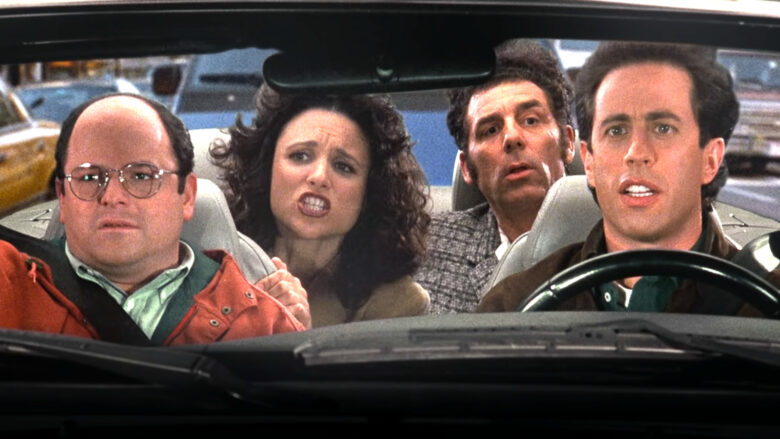
A week before the series aired what’s often deemed one of the worst TV finales of all time, “Seinfeld” released an episode that was controversial for different reasons: “The Puerto Rican Day,” which featured Kramer (Michael Richards) accidentally lighting a Puerto Rican flag on fire and then stomping on it. The stomping was intended to put out the fire, but paradegoers didn’t know that. They chased after Kramer and later threw Jerry’s car down a stairwell. Kramer remarked about the chaos, “It’s like this every day in Puerto Rico.”
While it often ranks on lists of “Seinfeld” episodes that have aged terribly, for some Puerto Rican viewers, the episode was terrible from day one. “It is unacceptable that the Puerto Rican flag be used by ‘Seinfeld’ as a stage prop under any circumstances,” said Manuel Mirabal, president of the National Puerto Rican Coalition, to the Pittsburgh Post-Gazette. “The flag is a symbol of a proud people and a standard of honor … it is nothing to laugh about or disrespect.” In the week after the episode aired, protesters demonstrated at the Rockefeller Center in Manhattan where NBC is based.
NBC quickly apologized for the episode, clarifying that “the broad comedy of ‘Seinfeld’ does not in any way take away from the respect we have for the Puerto Rican flag.” A few weeks later, NBC announced they wouldn’t play the controversial episode during the show’s reruns. It would take over four years before NBC allowed the episode to be included in syndication.
Why the backlash to the episode was so severe
Critics noted in the episode’s aftermath that perceived disrespect towards the Puerto Rican flag was a particularly sensitive issue, as the U.S. made it illegal for Puerto Ricans to display it from 1948 to 1957, turning the flag into not just a celebration of Puerto Rico, but a symbol of colonial resistance.
It wasn’t just the flag-burning scene that put the episode on the skip list for some “Seinfeld” viewers, either. Manuel Mirabal described the one-off Puerto Rican characters in the episode as overly stereotypical, saying they “dress in clothing that has not been worn in 40 years.” One Puerto Rican Bronx resident told the Daily News, “The part that really bothered me is when Elaine says, ‘All the Puerto Ricans in the world are here.’ It’s how she says it. It’s like we’re swarming Fifth Avenue illegally.”
Rosalyn Weinman, NBC’s executive vice president, released a statement defending the episode: “We believe the comedy was aimed, as always, squarely at our own characters’ ridiculous, misguided behavior, not at the Puerto Rican community,” she wrote. However, some Puerto Rican viewers were unfamiliar with “Seinfeld” and its comedic style prior to the episode airing. As one San Juan-based reporter noted, many of the territory’s residents tuned in for the first time because the episode was publicized beforehand as the “Puerto Rican Day Episode,” only to make a poor first impression.
Eventually Seinfeld made peace with the protesters
Jerry Seinfeld explained in a behind-the-scenes feature that he never considered the outrage against the episode to be fair. He recalled talking to “the head of some sort of Puerto Rican pride coalition” and asking him, “But you haven’t seen the episode yet. How do you know that there’s something in it that you want to protest?” Seinfeld recalled the man’s response, “We assume that it’s offensive.”
Jason Alexander, who played George Costanza, believed the protesters misunderstood the episode’s humor. “If it’s a shot on anybody, it’s a shot on Kramer,” he said. Seinfeld argued a similar point, saying that the plot of the episode simply revolved around the “terrible traffic snarls” parades of any kind cause in New York City. Seinfeld never officially apologized for the episode, and was still dealing with protesters demonstrating outside his stand-up show on Broadway three months later.
Heading into one of his shows, Seinfeld reportedly waved a white handkerchief at the protesters and mouthed “I’m sorry.” George Shapiro, a “Seinfeld” executive producer, recalled an incident after Seinfeld’s final show at the theater: “Seinfeld comes out of the stage door and, across the street, are the protesters,” Shapiro said. “And before anyone could notice, Jerry strides across the street with his long strides, goes up to the guy, shakes his hand … He shook a couple of people’s, and it sort of diffused the whole thing.”