
The fact that, despite many years of development, no one has managed to give us a remake of “Logan’s Run” in 50 years almost makes you believe in the existence of a benevolent intelligence controlling filmdom. Not that the original film, released by MGM on June 23, 1976, is a masterpiece beyond improvement. As a matter of fact, the film is quite flawed. But despite those shortcomings, it is, through and through, a snapshot of a particular turning point moment in the culture.
Those of you in the middle sliver of a Venn diagram of film nerds and science-fiction fans already know the film came out exactly 11 months before a little film by George Lucas changed everything forever. And so it is all but impossible not to look at “Logan’s Run” as the last gasp of a certain kind of horny science-fiction, forever vanquished by The Force.
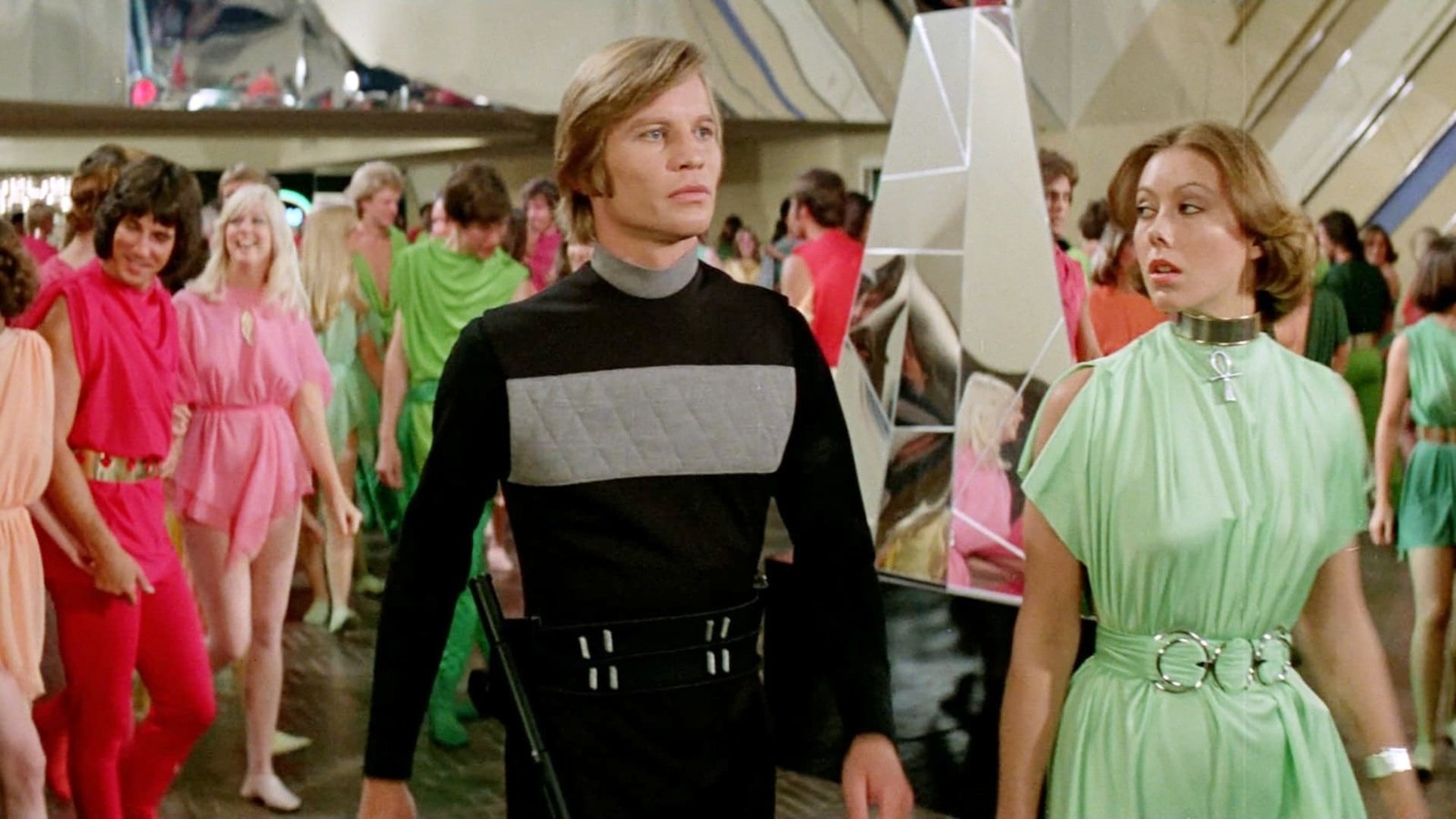
Based on the same-titled 1967 novel written by William F. Nolan and George Clayton Johnson, the film—directed by English journeyman filmmaker Michael Anderson—is set in a 23rd-century utopia that could only have been imagined in the Summer of Love. Beautiful young people swan about in colorful, lightweight tunics, living in a giant mall in a domed city. There is no work, no marriage, no nature. There is only pleasure and spectacle. And the One Big Rule: You die at 30.
Apparently, the original novel set the city denizens’ lifespans at 21, but the filmmakers thought that would be too limiting for casting. Michael York played the eponymous “sandman” (which, in this world, is the closest equivalent to the police, but the only crime they are charged with stopping is the cardinal sin of “running”—trying to escape the city to dodge the death sentence) named Logan 5. His partner, Francis 7, is played by the late Richard Jordan.
Both men were over 30 when the film was made. Jordan was actually pushing 40. Yet somehow, the gap between their characters’ ages and their own serves the film. It’s as if the depravity of their professional violence (when we see them dispatch a runner in the film’s first third, they treat it like two office workers making sport of who can land buckets in the wastepaper basket) has aged them prematurely.

The decision to make 30 the cut-off was fortuitous. Because the film, in this way, marked the beginning of the Baby Boomers turning 30 with its release. Much has been made of the film as a critique of ’70s Boomer hedonism. This is the Me Generation projected into a gleaming but dark vision of the future. I have referred to the film’s setting as a utopia up to now, but if science fiction has taught us anything, it’s that a utopia is just a dystopia without scrutiny.
It is particularly rich to look at this city from the perspective of the present day. The city is run by AI, which means the villain in the film is, like much of the best science fiction, a system and not a person. Spectacle has become a religion. Those becoming tricenarians submit to a ritualistic public euthanasia that looks like a Las Vegas floor show. The show is called Carrousel [sic]. They are lustily cheered on as they die with the idea that their pyrotechnic ends are a sacrifice for the community and that they will be “renewed,” born again in one of the city’s incubators (reproduction is now handled by the machines, meaning sex is now purely a recreational pursuit).
The city’s emphasis on death as spectacle is the first clue that this is actually the bad place, and it should be noted that Carrousel was an invention of the screenwriter, David Zelag Goodman, and it did not appear in the novel. Cinema’s need for spectacle dovetailed beautifully with the decadent ethos of this dystopia.
If you’ve ever talked to a science fiction aficionado of a certain age, you know that the genre was positively libidinous before “Star Wars.” “Logan’s Run” has become a relic of that era. After a day of death dealing, Logan (at home, clad in a fantastic black caftan) orders up a sex partner who appears in his bachelor pad via teleporter. The first choice the AI gives him is a man, and Logan effectively swipes left with a look meant to telegraph to us that Logan is straight (or that he simply found that particular man too eager).
Finally, he settles on Jessica 6 (played by Jenny Agutter, who was actually under 30 at the time she made the film). When she seems reluctant to perform as a willing sex partner upon meeting him, Logan asks her if she prefers women instead. It should be noted that his tone is casual, without rancor, suggesting that bisexuality is widely accepted in this world.

The absence of conspicuous consumption remains one of the most striking bits of world-building in “Logan’s Run,” despite a mall in Dallas serving as the city’s central public location. It’s almost inconceivable that the absence of consumerism and materialism would exist in the film had it come along just 7 or more years later. The ’80s forever robbed us of the idea that capitalism was something the human race would inevitably simply evolve past in the next few centuries (see also the anti-capitalist wokeness known as “Star Trek”).
Much as Trinity sends Neo on his quest in “The Matrix” (a film that has many structural similarities to “Logan’s Run”), Logan’s interaction with Jessica raises questions for him about what he has always accepted as normal. She sets him off on a journey that will take him, literally and figuratively, beneath and outside the world he’s known and call everything into question. Watching it this time reminded me of the work of Peter Weir, who, time and time again, told stories about people who realized something (so huge that they’d been taught not to see it) and how this new knowledge changed them forever.
Logan and Jessica’s run take them through abandoned churches, a sex club (despite a lot of skin and even some bare breasts, this film was rated PG—welcome to the 1970s), and even a gatekeeping murderous robot voiced by the inimitable Roscoe Lee Browne (a sonorous Black man’s voice being issued from a metallic figure cannot help but feel like a precursor to Darth Vader, but unlike James Earl Jones, Browne actually performed from inside his cumbersome robot suit). Browne’s voice drove home another curious feature of the film: the complete (or at least nearly total) absence of people of color in this future. Lest we get too nostalgic, it’s always good to keep in mind how often “utopia” meant “whites only” in films of a certain era.
By the time Logan and Jessica reach the outside world—with Logan’s former partner relentlessly on their heels like a demented Inspector Javert—the film has begun to feel like both ancient myth and also a reworking of the Book of Genesis. They are a new Adam and Eve, perhaps in reverse, finding themselves in paradise after regurgitating the apple. Until we realize this Eden is, of all places, Washington, D.C. In the decayed Halls of Congress, now overgrown with flora and taken over by cats, they meet an old man (played by Peter Ustinov), confront their pursuer, and then head back to the city for one last showdown with the machine that has kept humanity imprisoned in an endless adolescence of the soul.
Upon release, “Logan’s Run” made $25 million against a then-voluminous $9 million budget. It was a modest hit and spawned an ill-conceived, short-lived TV series. Critics were mixed on it: Roger Ebert shrewdly saw it as neither a masterpiece nor an abomination, calling it a good time and not much else. The film won a special Academy Award for its special effects work, and was also nominated for its cinematography (shot in the 2.4:1 aspect ratio using the Todd-AO system by Hungarian-born cinematographer Ernest Laszlo, A.S.C.) and for its production design (by Dale Hennesy).
It’s no small feat for the film to have remained as much a part of the culture as it has for the last 50 years. It has been valuable as a reminder of how hedonism and youth culture can be weaponized by a faceless enemy that maintains a murderous status quo. In the end, the youngs meet Ustinov’s alter ego with naked awe. A big part of his character is that he is the product of heterosexual monogamy, something alien to this world. So it isn’t a stretch to think that he will, in time, indoctrinate the youth into traditional marriage.
The film, years before 1980 and the rise of Reaganism, seems to understand that the party is over. The youth will grow up at last, and most likely, that will mean doing a lot more work and having a lot less sex. A better film might have suggested a more radical re-imagining of their world to come, but the beauty of a film without a sequel or a remake is that you get to decide what comes next.