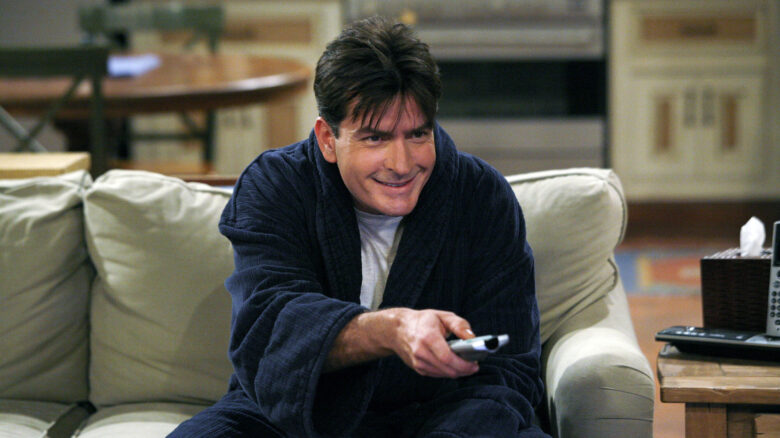
Blending odd couple parenting dynamics with an irascible lead performance, at least before star Charlie Sheen’s unceremonious exit, “Two and a Half Men” was a television staple. Running for 12 seasons, Sheen played lothario bachelor Charlie Harper, who lived with his timid younger brother Alan (Jon Cryer) and Alan’s son Jake (Angus T. Jones). Charlie’s antics gently deconstructed the typical domestic sitcom tropes, particularly through the numerous dangerous liaisons that he found himself entangled in. The show was created by prolific television producer Chuck Lorre and Lee Aronsohn as part of the former’s sprawling TV empire.
For longtime fans of “Two and a Half Men,” there is no shortage of shows that similarly evoke the tone of the hit CBS series. We’re specifically highlighting sitcoms with a more sardonic edge to them and shows that feature some of the creative talent from “Two and a Half Men,” both on-screen and behind-the-scenes. These are the 15 best TV shows like “Two and a Half Men,” each offering a wry approach to the usual sitcom format.
Everybody Loves Raymond

Compared to its contemporaries like “Friends” and “Frasier,” “Everybody Loves Raymond” doesn’t get the modern recognition it deserves. At first glance, the show looks like any number of suburban family-based sitcoms that aired in the ’90s, focusing on Ray Barone (Ray Romano) and his family in Long Island. But there is a quiet maturity to the types of stories that the show told across its nine-season run and the familial dynamics that Barone endured. The Barone family is rife with jealousy and resentment that often places Ray in a mediator role, which is where both the show’s humor and heart are rooted in.
It’s that subtle sophistication in exploring family dynamics in a franker manner than most network television shows that earns “Everybody Loves Raymond” a spot here. The gags are rooted in an emotional authenticity and while the Barones are more capable parents than the Harpers, they still struggle with those responsibilities. A lot of that enjoyment comes from how well the ensemble cast gels together, spearheaded by Romano himself. Definitely a cut above the more generic sitcoms of its era, “Everybody Loves Raymond” was a reliably entertaining television staple for nearly a decade.
Spin City
Charlie Sheen’s first starring role in a long-running sitcom was for the 1996 series “Spin City,” though he didn’t join the show until its final two seasons. The show takes place within the mayoral office of New York City, initially following Deputy Mayor Mike Flaherty (Michael J. Fox), who actually runs the city. Charlie Sheen replaced Michael J. Fox on “Spin City” after Fox’s Parkinson’s disease symptoms started to worsen. Sheen stars as Flaherty’s successor to the office of Deputy Mayor, Charlie Crawford, who contends with his own issues while trying to help run the city.
There is some irony in considering that Sheen replaced a sitcom star for its final seasons just as he himself would be replaced from his starring sitcom within a decade. But at least Fox’s departure from “Spin City” was both his choice and one with substantially less behind-the-scenes drama than Sheen leaving “Two and a Half Men.” Beyond these casting changes, the ABC series offers much more wholesome comedy, at least as far as political satire is concerned. An early television showcase for Sheen’s sitcom chops, “Spin City” gives him another lead character trying to do better with his life.
Dharma & Greg
Before “Two and a Half Men,” Chuck Lorre co-created the hit sitcom “Dharma & Greg” with Dottie Dartland in 1997. The show centers on couple Dharma Finkelstein (Jenna Elfman) and Greg Montgomery (Thomas Gibson) who impulsively decide to get married on their first date. The series explored the implications of this hasty marriage, especially given their differing backgrounds and perspectives. Despite it all, the couple’s love ultimately keeps them happy and together across the show’s five seasons.
“Dharma & Greg” plays out like a variation of “The Odd Couple” if its protagonists were married rather than just being roommates. Elfman, in particular, really shines as the free-spirited Dharma, giving the show its clear sense of fun. As an added nod between Lorre’s later work, Dharma and Greg actually appear in the “Two and a Half Men” episode “Nice to Meet You, Walden Schmidt.” Informing the diametric dynamic that defined Charlie and Alan Harper’s relationship in Lorre’s later work, “Dharma & Greg” features a more pronounced opposites attract pair.
Two Guys and a Girl
When it comes to actors known for their penchant for sarcastic comedy, like Charlie Sheen, Ryan Reynolds and Nathan Fillion definitely thrive with those qualities. The two actors starred together in the 1998 sitcom “Two Guys and a Girl,” initially set in and around a Boston pizza parlor. Reynolds stars as Berg, a 20-something slacker who eventually decides to go to med school. Fillion joins the show in the second season as Johnny Donnelly, a repairman who becomes part of the core friend group.
For fans who know him better as the wise-cracking Deadpool, it may be a shock to see Ryan Reynolds headlining a forgotten ’90s sitcom. But even on network television, Reynolds’ comedic strengths are on clear display, benefitting his character’s mischievous hijinks. Even with the subsequent star power involved, the show gets lost in the ’90s sitcom shuffle but still holds up nearly 30 years later. Providing a 20-something approach to slackers-done-good, “Two Guys and a Girl” is breezily lightweight fun with strong leads that went on to bigger things.
That ’70s Show
After Charlie Sheen was terminated from “Two and a Half Men,” he was replaced by Ashton Kutcher for the show’s final three seasons. Playing new character Walden Schmidt, Kutcher complemented Cryer’s neurotic housemate role as the Harper household’s newest eligible bachelor. Of course, years before stepping up in this capacity, Kutcher became a household name with his own breakout sitcom role on “That ’70s Show.” Kutcher played proto-himbo Michael Kelso, whose dim-witted nature fueled all sorts of teenage and young adult mischief on the period piece comedy.
While certainly more of a buffoon, viewers can see the foundation for Kutcher’s performance as Walden Schmidt in Kelso. Both characters are charming in their own right and demonstrate Kutcher’s willingness to lean into the goofier side of comedy, occasionally even veering into slapstick. Those qualities remain in the short-lived Netflix revival “That ’90s Show” while repositioning Kelso as a family man. Providing an opportunity to see Kutcher develop his sitcom chops, “That ’70s Show” holds up nearly 30 years since its premiere.
The King of Queens
Providing a working-class perspective on the nuances of domesticity, “The King of Queens” was a CBS staple for nine seasons. True to its title, the show centers on married couple Doug (Kevin James) and Carrie Heffernan (Leah Remini) living in New York City’s Queens borough. Constantly dreaming of moving up in the world, much of the series revolves around Doug’s half-baked schemes to make good. Joining the couple in their home is Carrie’s father Arthur Spooner (Jerry Stiller) who adds his own wry perspective to their relationship.
Doug’s constant schemes and more duplicitous side echo Charlie Harper’s own more self-centered tendencies in “Two and a Half Men,” albeit without the womanizing. That said, it’s clear that Doug is a loving husband who genuinely cares about his wife in his own way. The addition of Jerry Stiller also does wonders for “The King of Queens,” with the comedy veteran as sharp as ever. Taking place within the same universe as “Everybody Loves Raymond,” “The King of Queens” offers a more blue-collar approach to its portrait of domesticity.
Becker
Ted Danson made his big return to sitcoms after his long-running starring role on “Cheers” with the 1998 show “Becker.” Danson plays John Becker, a physician who runs a small medical clinic in the Bronx. In contrast to Danson’s “Cheers” role, Becker is an absolute curmudgeon who seems to be annoyed by everything, especially his patients. Despite this, he still displays moments of compassion and empathy, often brought out by his love interests in the series, starting with Reggie Kostas (Terry Farrell).
Though not remembered among the best Ted Danson TV shows, “Becker” has its own irascible charm. This is Danson at his most curmudgeonly on television, but he still knows when to deftly weave in likable moments for his character. Though not nearly as successful as “Cheers,” the show still ran for six seasons while demonstrating a different direction for Danson’s comedic talents. Another sitcom centered on a lovable cynic, “Becker” is a forgotten ’90s comedy worth revisiting.
Titus
Like Jerry Seinfeld and Ray Romano before him, stand-up comedian Christopher Titus parlayed his comical stylings into the 2000 sitcom “Titus.” In the show, Titus plays a version of himself who owns a custom car shop in the San Francisco Bay Area. The series revolves around Chris’ dysfunctional relationship with his family, specifically his younger brother Dave (Zack Ward) and his father Ken (Stacy Keach). This blue-collar ensemble provides their own perspectives on the foibles of contemporary life, including confessional sequences with Titus filmed in black-and-white.
As far as edgy sitcoms in the early 2000s go, “Titus” revels in its own mean streak. Chris Titus is like a Charlie Harper without the loving family unit to at least offer him the chance at redemption. Instead, Ken stands as politically incorrect as father figures on network television get, giving his sons a foul-mouthed foil. A much more cynical sitcom for its era, “Titus” ran for three seasons before receiving a double-sized finale in 2020 to close out its narrative.
Grounded for Life
Another sitcom rooted firmly in family dysfunction, albeit with much more heart than “Titus,” is the 2001 series “Grounded for Life.” The show centers on working-class parents Sean and Claudia Finnerty, played by Donal Logue and Megyn Price, respectively. After having their first kid when they were teenagers, the couple raises a growing family in Staten Island. This informs plenty of the foibles that the ensemble endures, especially linked to their eldest child Lily (Lynsey Bartilson) as she progresses into her teenage years.
Even with its family full of character flaws, there is a lot of heart to “Grounded for Life” that elevates it. Like “Two and a Half Men” after it, the show intuitively recognizes that familial dysfunction doesn’t need to be mean-spirited in its interpersonal strife. That distinction keeps the characters likable, even as they clash and make loads of relatably everyday mistakes. Offering a blue-collar alternative to suburban domesticity that’s intentionally rough around the edges, “Grounded for Life” is an unassuming good time.
My Name Is Earl
When it comes to ne’er-do-well protagonists who are trying to turn their lives around, redemption is the name of the game in “My Name Is Earl.” The 2005 series stars Jason Lee as Earl Hickey, the small-time scoundrel living in rural California. After enduring a harrowing accident, Earl sets out to rectify all the malicious wrongs that he committed throughout his life. A winning lottery ticket helps facilitate Earl’s crusading atonement while cementing his newfound belief in karma.
A lot of the appeal from “My Name Is Earl” comes from Lee’s laidback goofy charms, complemented by supporting actors Ethan Suplee and Jaime Pressly. Another enjoyable aspect in each episode is seeing just how much of a dirtbag Hickey was before deciding to repent from his wicked ways. Though “My Name Is Earl” was cancelled after four seasons, leaving its protagonist’s quest incomplete, it still offered plenty of laughs. Telling the tale of an admitted buffoon trying to make the world a better place, “My Name Is Earl” offers easygoing entertainment.
Californication
Telling the tale of a much more salacious ladies’ man and his sexual misadventures, “Californication” offers a change of pace for lead actor David Duchovny. Starring as author and single father Hank Moody, Duchovny’s 2007 Showtime series revels in the possibilities of unchecked vice. To be sure, Hank is a Casanova with a heart of gold but, just like Charlie Harper, can’t help himself when temptation arises and it often does. Running on a premium cable channel, the series doesn’t hold back in depicting its depravity and the consequences that result.
In looking at this whole list, “Californication” is definitely something of an outlier in terms of tone and presentation. At first glance, the show feels like a prestige drama, but there is plenty of humor to be had, especially given Duchovy’s wry performance. It’s more than just Hank who’s flawed, but Duchovny and co-star Evan Goldberg really embrace how ridiculous some of these carousing antics can get in order to sell a gag. “Californication” stands as one of the best Showtime shows of all time, the type of dramedy that excels at both earning laughs and character-driven melodrama.
The Big Bang Theory
Chuck Lorre followed up “Two and a Half Men” with an even more massive success in “The Big Bang Theory,” which ran for 12 seasons from 2007 to 2019. For the uninitiated, the show centers on a group of scientific geniuses and pop culture geeks navigating life and love together. As gifted as these characters are in regard to scientific acumen, they are tightly wound up and socially awkward. This, along with an absolute parade of pop culture references, is what informs much of the show’s comedy.
A lot of the sitcom humor that made “Two and a Half Men” so endearing is present in “The Big Bang Theory” but reoriented for younger characters. However, whereas Lorre’s earlier series had one overly neurotic character, the latter dials this up to four anxiously uptight figures. But, given the show’s lengthy run, the series also allows its characters to grow and evolve, heightening our investment in their journey. Still producing spin-offs seven years after the main series’ conclusion, “The Big Bang Theory” is a network comedy phenomenon.
Anger Management
Charlie Sheen bounced back relatively quickly after his public “Two and a Half Men” dismissal, signing on as the lead for the FX sitcom “Anger Management.” Loosely based on the 2003 Adam Sandler comedy movie of the same name, Sheen stars as former baseball player Charlie Goodson. Turning his talents to become an anger management therapist, despite his own clearly glaring issues on the matter himself, Goodson navigates this career change and single fatherhood. In response to the first season’s ratings success, FX renewed “Anger Management” for 90 extra episodes and signed Martin Sheen to join the cast as Charlie’s father, echoing their behind-the-scenes relationship.
Developed with Charlie Sheen’s bad-boy reputation in mind, “Anger Management” gives him a raunchier and more volatile role to play with. Benefitting from being broadcast on basic cable, as opposed to network television, the show could appropriately get edgier with its subject matter and often did. With all that in mind, your enjoyment of Sheen’s follow-up sitcom really rests on how much you can appreciate him playing up his naughty persona. Going largely unfiltered with its rogue lead, “Anger Management” ditches the wholesome aspects of “Two and a Half Men” for something darker and more mature.
Mike & Molly
Compared to other Chuck Lorre shows on this list, “Mike & Molly” features one of the more harmonious couples at its core. Premiering in 2010, the show centers on the rapidly developing romance between police officer Mike Biggs (Billy Gardell) and Molly Flynn (Melissa McCarthy). Over the course of the series, this relationship grows from a casual coupling to marriage and an attempt at having children. The sitcom’s humor is primarily drawn from the easygoing chemistry between its leads but also the supporting cast playing the couple’s good-naturedly grumpy family and friends.
Any sitcom starring Melissa McCarthy is worth watching and “Mike & Molly” serves as a fantastic showcase for her comedic talents. Her and Gardell play off of each other perfectly, keeping things sweet and funny without veering into overt sentimentality. The sardonic and cynical elements of the humor comes from the supporting cast, not so much the leads, offering a nice complement to the dynamics. Running for six seasons until 2016, “Mike & Molly” is the coziest sitcom on this list.
Mom
One last Chuck Lorre show to close things out, “Mom” followed a household with different kinds of flawed characters bonded together as a family. The show initially centered on single mother Christy Plunkett (Anna Faris), who lives with her mother Bonnie (Allison Janney) in Napa, California. Both women struggle with addiction, helping each other stay sober as they try to improve themselves. This includes the both of them getting into various romantic entanglements and serious relationships over the course of the series.
Compared to “Two and a Half Men,” “Mom” takes the flaws of its main characters much more seriously. This adds a greater emotional resonance to their dynamics and arcs, but the show still finds plenty of time to deliver on the laughs too. CBS pulled the plug on “Mom” after eight seasons, giving its lead characters the happy ending that they deserved. And the journey to get to that conclusion was well worth it, paying off on a longstanding story all above recovery and self-reclamation.