[Editor’s note: The following review contains spoilers for “Widow’s Bay” Episode 10, “We Hope You Enjoyed Your Time!” — the Season 1 finale.]
When the mayor of a town drives through a wicked storm to check on his elderly assistant, he’s supposed to be making sure she’s alive, not hoping she’s already dead. That’s just not how people are meant to behave, especially our scripted protagonists: love thy neighbor, do the right thing, with great power comes great responsibility, yada yada yada, you get it.
But even before Tom Loftis (Matthew Rhys) flees the relative safety of Town Hall’s outdated “shelters,” the Lord Island Protector of Widow’s Bay is crossing his fingers that Ruth Livingston (K Callan) — the work-shy secretary who’s also, reportedly, the last living descendant of town founder Richard Warren — has already met her maker, so he can be spared the unpleasantness of introducing them himself.
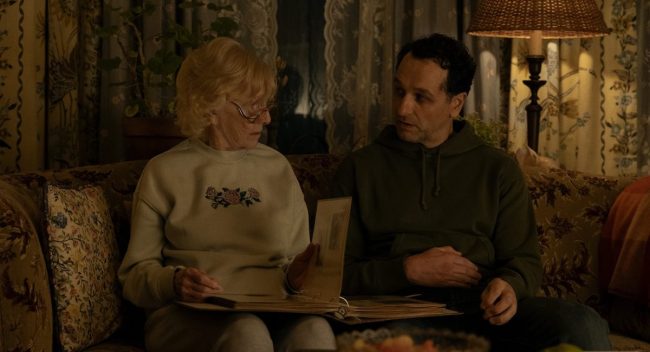
When he goes through her medical files, he’s desperate to find a cancer diagnosis. When he knocks on her door to no answer, he turns every corner as if he’s about to spot a corpse. When Ruth falls asleep mid-conversation — after Tom covertly mixes her not-to-be-mixed medications — he apologizes without expecting an answer, let alone forgiveness.
But Ruth refuses to go quietly into the dark-and-stormy night. She’s in great health for her age. (Her medical file contains a handwritten note that just says, “Wow!”) She doesn’t hear Tom knocking because she’s busy walking two miles on her treadmill, and her active lifestyle isn’t limited to exercise: She has “a very full calendar,” by Tom’s own account, including Story Club, Aqua Aerobics, Librarian’s Knitting Classes, and helping her neighbor Deidre up and down the stairs every day.
Once it’s clear Ruth isn’t on her last legs, the conflict-averse mayor (he even ran for office unopposed) is forced to make the very decision he was hoping to avoid: Should he kill Ruth to end the island’s curse and protect its remaining inhabitants? Really, he wonders, should he do it? He clearly doesn’t want to, given how many outs he tries to take, but Wyck (Stephen Root) is louder in his adamant support of the idea than Patricia (Kate O’Flynn) is in her rejection of it. Perhaps more importantly, Tom’s fear of what will happen if he doesn’t kill Ruth is stronger than his faith in a way forward with her still around.
And that’s when “Widow’s Bay” provides a clarifying peek into Tom’s traumatized worldview. Lauren, Tom’s late wife, had a stroke on a ferry ride when they tried to leave the island, and she only deteriorated from there. Rendered catatonic after giving birth to Evan (Kingston Rumi Southwick), she spent the rest of her all-too-few days in a psychiatric hospital before passing away when her son was still too young to remember her.
Before he lost Lauren, Tom says he would laugh off her theories about the island. “I teased her about it,” he says. “I don’t understand why I didn’t just listen.” But after Tom became a widower, he “knew” those warnings were real. “And I still brought tourists here. Because I wanted more for him. And myself. And now I’ve put all these people in danger. … I’m sorry,” he says, thinking Ruth is dead. “But I had to make it right.”
For a few seconds, it seems like Tom crossed an uncrossable line. And yet his reasoning pulls us past that same moral boundary with him. His rationale doesn’t excuse what he tried to do, but it does explain it. Between Ruth and Evan, old and young, friend and family, Tom chooses the latter. He knows he can’t keep Evan on the island much longer, just as he knows he can’t suffer another loss like he did with Lauren. If Evan took that ferry to Boston and the curse was still active, would Tom — who wasn’t born on Widow’s Bay and thus isn’t bound to it like the locals — have to watch his son die in the same slow, agonizing fashion that his wife did?
It’s a horrific thought, the kind of idea anyone would be eager to push out of their mind before it feels too real. But for Tom, it already does. He’s living in a “house of horrors,” like he tells Ruth, and he has to find a way out. That desperation has been eating away at him long before “Widow’s Bay” began, and it’s been steadily rising throughout the first season.
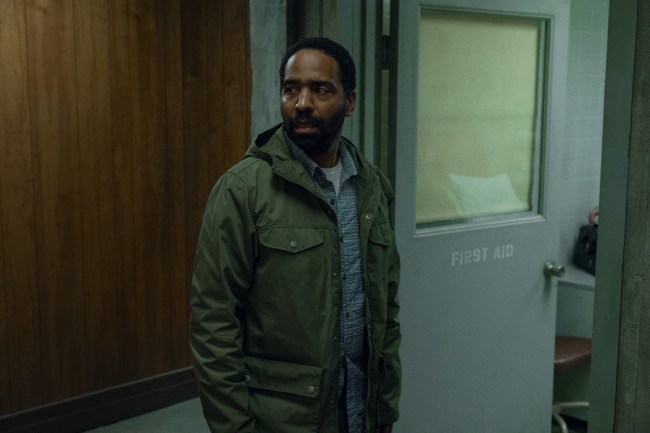
But here’s the thing: Even before we find out Ruth isn’t actually the last descendent — that she had an affair with Lauren’s father, which makes her Evan’s grandmother, which means if Tom wants to end the curse, he’s going to have to pull the lever and send the trolley over his own son — even before Tom reverses course and decides to save Ruth, first from his clumsy poisoning and then from Clemmons’ gunshot, she gives him the out he’s been searching for, just not the one he can hear:
There is no protecting Evan. There’s no way to ensure Evan will be spared an early grave, just as there’s no way to ensure Tom will be spared from further trauma.
That’s just life. “The world is violent and mercurial,” Ruth reads from her cross-stitch(!) of a Tennessee Williams quote. “It will have its way with you. … We live in a perpetually burning building, and what we must save from it all the time is love.” That’s a nicer way of saying life and loss are inextricably linked, so all you can do is the best you can, while you can. The horrors will find their way into your house, just as you’ll find the inevitable exit awaiting us all, but the best shield against anguish isn’t fearful avoidance; it’s virtue, faith, and acceptance — it’s being the kind of person a father, a mayor, and a friend is supposed to be.
Maybe Tom can become that man, maybe he can’t. Maybe he’ll laugh again one day, or maybe he’ll keep contorting his face into infinitely entertaining variations of terror. All we know now is he’s a long way from safe harbor, and he’s facing quite the stormy sea.
A lot has been said about what’s made “Widow’s Bay” a minor sensation in these early days of summer, and a lot of those observations are right on the money. There’s director Hiro Murai’s mastery of tone, creator Katie Dippold’s accessible and effective blend of creeps and comedy, Rhys’ incredible expressions, O’Flynn’s breakthrough performance, the craft team’s attention to detail, and the confidently constructed lore that rewards the viewer’s active attention.
Onto that incomplete list of attractions, let’s add one more: “Widow’s Bay” is about a man who’s indecisive, but the show around him is thrilling in its decisiveness. Just look at how the season started: In the first two episodes, it’s unclear if the horrors Tom witnesses are real or imagined. A more exhausting, stretched-out version of “Widow’s Bay” would’ve taken hours, even seasons, to confirm that Tom’s not crazy; that the killer clown in the motel and the old woman who clawed his arm weren’t merely figments of his imagination.
But Dippold’s version doesn’t dillydally. When the Sea Hag has Tom trapped in his bathtub, Wyck shows up in the nick of time to blast her to oblivion. The petrified Lord Island Protector looks at his unexpected savior and asks, “Why is this happening?” Wyck stares back at him and says, “I don’t know. You just… survive it.”
That blessed choice — to not only acknowledge what Tom’s going through is real, but to unite him with the rest of the core cast so they can fight back together — sets up the wildly imaginative episodes immediately thereafter: Episode 4, “Beach Reads,” with Patricia’s ill-fated party; Episode 5, “What to Expect on Your Trip,” with Tom’s hallucinatory drug trip; Episode 6, “Our History,” the town’s origin story that, unlike other momentum-sapping flashback episodes, launches us immediately into Episode 7, where Richard Warren (Hamish Linklater) rises from his grave to greet his mayoral successor.
Season 1 is so exciting because Tom wants what we all want — to feel safe and happy in our community — and yet he’s trapped in a house of horrors that doubles as an eerie mirror version of our own reality. These days, fear and absurdity walk hand in hand, and anyone who’s scrolled a news feed knows how quickly abject terror can morph into cathartic giggles. “Widow’s Bay” recreates the experience through its own laws and customs, its own heroes and villains, its own horrors and howls. Today, Tom laments laughing at his wife’s theories about the island’s curse, but taking the opposite tact and operating from a place of fear isn’t the safeguard he may think. It isn’t going to save his family. It just means he’s not having fun anymore.
Sure, in the end, you may regret laughing at the thing that kills you, but then again, in those final seconds before it’s all over, you may regret not laughing more.
“Widow’s Bay” is available on Apple TV. The series has already been renewed for Season 2.