When Industry premiered during the thick of the pandemic, in November 2020, critics swiftly jumped on board — but audiences were slower to find the thrilling drama, which centers on ambitious young graduates navigating their new life in a cutthroat London investment bank. As the HBO show took some wild twists and turns, welcoming starry new castmembers like Kit Harington along the way, reviews stayed top-tier and the ratings started catching up. The fourth-season premiere jumped 20 percent year-over-year.
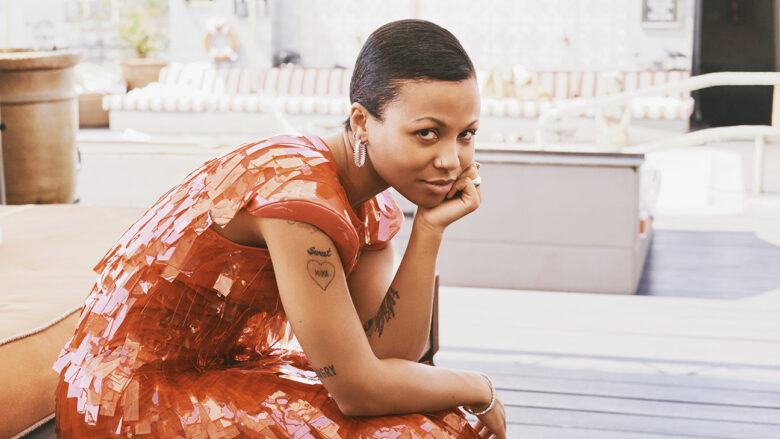
Long off the Emmys’ radar, Industry suddenly feels like a player. Last year, Marisa Abela won a BAFTA for her central role, and now all eyes are on fellow original star Myha’la, who got her biggest showcase yet in season four as the mercurial, brilliant, self-destructive Harper Stern. This batch of episodes saw her grieving the death of her estranged mother, reeling from the departure of her longtime mentor Eric (Ken Leung) and taking some huge risks — as ever — to keep her own new fund afloat.
The next season will be Industry‘s last. “I just read some very early drafts of the first and second episodes, which are very exciting — classic Industry,” Myha’la says as we begin our chat. “No, I can’t tell you anything.”
Season four finds Harper at her most vulnerable. What was it like preparing for that?
The question is always like, “Who is she without the trade? What makes her tick?” And since all these characters are evolving, she can’t just be the same Harper from season one and two. She’s 10 years older than she was when we met her. So going into it, all of us were really looking forward to exploring what it looks like when her heart really gets involved in something, or if she gets challenged emotionally in a way that she’s not used to.
Take the situation with Eric: She has spent her entire young adult life avoiding family, avoiding getting her feelings hurt, and when she finally has no more family and she needs someone, he’s the closest thing to it. She says to him so many times in the season, “I know what happens if we’re vulnerable with each other, it will ruin everything.” Her prophecy is fulfilled. What’s cool about diving into uncharted waters with a character I know so well is that it didn’t require a kind of prep that I might do for something else. I put myself in her shoes and just let the emotion of it all wash over me.
Did you surprise yourself in the way she, and I suppose you, responded?
One hundred percent. The amount of heartbreak I felt over Eric’s departure was just as shocking as the heartbreak I felt when her mother died. You’d think somebody who’s done their best to separate themselves from someone who traumatized them so hard wouldn’t have a tear to cry, but it was very much an unhealed piece of her inner child who just wanted her mommy to love her. She also feels all this resentment, like she’s been robbed of her opportunity to grieve or to have a confrontation, because who knows if that was down the line? I was surprised at how heavy those things were. But it humanizes her. That is the crux of the season: discovering Harper’s humanity in a way that people — and I — weren’t expecting.
Myha’la (left) as Harper Stern with Marisa Abela as Yasmin Kara-Hanani in Industry.
There was a lot of fan reaction to not seeing Harper’s mother onscreen, and then, of course, this gut punch comes. I know you’re online, but were you tracking that?
Some of those episodes when we got them were 120, 130-odd pages — so if we had had the time, I am sure we all would have loved to have met Harper’s mom. We have 60 minutes. I would have loved to have seen a lot more. I still want to know what happened. If we could do a retroactive season and just film all of the BTS stuff that we don’t have time for, I’d love that. But you know what? That, to me, is telling me how invested people are in Harper. I am not sure there’s anyone I love more than Harper. She feels like a part of me. She feels like my sister, but also my friend who I think deeply needs therapy.
A hundred and twenty pages is wild for an hourlong drama.
They love to write. [Laughs.] It’s only punishing them in the edit, I don’t know why!
How have you experienced the overall rise of this show? There was fandom around it from the very beginning, but it’s blown up recently.
A few weeks after the finale dropped, I went outside, which I don’t do that often, and I was getting stopped — and that just didn’t happen before. The people who knew about us were a very niche, close-knit community. This was the first time someone was like, “Harper, I love you!”
You mentioned how close you feel to Harper. How have you bumped up against some of the poorer choices that she’s made over the course of the show?
I have to understand her so deeply to feel empathy, to know why she does the things she does, to justify them or at least explain them so that she’s not a bad person. I don’t think Harper is a villain. She’s not a bad person. She’s not evil. She doesn’t do things with the intention of hurting people, and she’s protective of her own very traumatized self. To make those choices feel authentic and grounded in reality, even if we don’t agree with them morally as the audience, I have to justify them to do them truthfully in a way that I can’t punish her for or judge her for. I also feel like it’s really dehumanizing, as a Black woman, watching Black women characters onscreen who are one- or two-dimensional and don’t feel complicated, don’t feel like they have a struggle. It makes me feel inadequate and judged for being a human being who holds contradictions and dichotomies and traumas and failures and successes. That’s why I chase roles like Harper. They affirm me in my humanity.
You have this deeply moving sequence with Marisa Abela in the penultimate episode, but by the finale, we see them at odds again as Yasmin starts down a disturbing new path. What did you make of where we leave them?
It was heartbreaking. Like watching — I was going to say a plane crash, but it’s way worse than that. It’s being able to watch, in slow motion, somebody set off a nuclear weapon to fly to another country to blow up a bunch of people. That’s what it felt like playing it. So much shock and confusion. Also real-time denial. At this point, Harper has been through so much — I think she’s also exhausted from all of it.
You advocate for the show strongly, and it’s no secret the Emmys have ignored it to date. Do you hope that changes this year?
I’ve been raised on the idea that I can be great without other people telling me that I’m great, and I truly believe that we have continued to pursue greatness fiercely without the need or hope for recognition because it’s just who we are and it’s what we do on this show. Obviously, we would love an Emmy. We would love to be recognized by the Television Academy. It’s the ultimate reward and stamp of approval. I would cry so hard if any of us won an Emmy. Marisa won a BAFTA for season three, and I freaked out because she deserves it. I believe we all do… There are so many great shows, so many critically acclaimed HBO cult classics that never got Emmy nods, some of the best shows of all time. I know that whether or not we are blessed with Academy recognition that we did something special that’s important to a lot of people. We did it from a place of love. That’s my Emmy speech.
This story first appeared in a June stand-alone issue of The Hollywood Reporter magazine. To receive the magazine, click here to subscribe.