
While watching Kristoffer Borgli’s “The Drama,” I thought a lot about Zendaya’s Blackness within the shell of this character. The film never questions her identity in any meaningful way. We know that she is biracial; this is acknowledged in the film’s text. We may also surmise that her race played some role in her bullying and that it plays some role in how she is treated by her fiancé and her “friends.” But the film is not interested in any of these possibilities beyond gesturing to them.
This is a pragmatic move on the part of Borgli (who is not just white, but foreign to the unique nature of racism in America), but it is not an original approach. The history of Hollywood is littered with far more directors who chose to avoid or even disregard race than those who’ve made a genuine effort to do something more daring. That lack ends up shaping Black actors, especially the Black movie star. There is a spectrum that defines the particulars of what the Black artist or movie star looks like. As Richard Dyer says in The Matter of Whiteness, “White people set standards of humanity by which they are bound to succeed and others bound to fail.”
Many of the stars of blaxploitation existed as stark examples of said cognitive dissonance. Pam Grier, Richard Roundtree, Fred Williamson, Glynn Turman, Marlene Clark, Vonetta McGee, Jim Brown, and Richard Pryor were all major movie stars of that era. But their stardom and appeal (despite being nearly as owed to white audiences as to Black) were viewed as specifically Black, and, as such, were not universal, standard, definitive, or normal. It was an aberration within the confines of what Dyer describes as “the dominant image of the world.” These stars would eventually be reduced to role players rather than leads in worlds dominated by whiteness, wherein they were sometimes as doomed to fail on-screen as they were off-screen.
The Black movie star, therefore, exists in what W.E.B. DuBois called “double mind,” a double consciousness of sorts—forced to view ourselves through our own eyes and through the eyes of those who other-ize them: white eyes. Under this guise, the tenuous history of the Black movie star (tracing from Bert Williams to Zendaya) finds its most recognizable marker in Sidney Poitier.
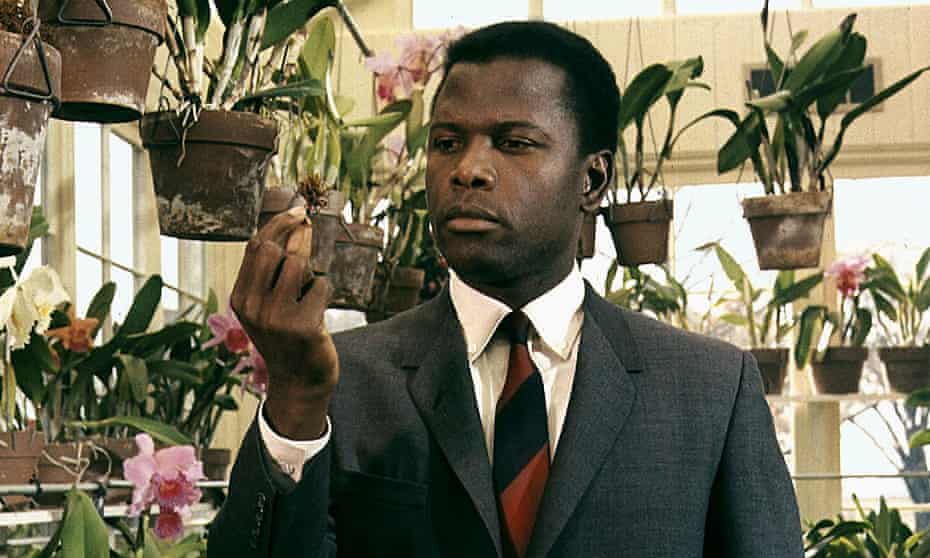
Both the front and back of Poitier’s career would see him performing within frames written and directed by white people. If Black social consciousness had never happened in the late ‘60s and early ‘70s, we might never have known Sidney any other way. James Baldwin once said, “He trembled for Sidney”—this was due to what Baldwin viewed as “in the terrifying position of being part of a system that you know you have to change.” Sidney acknowledges this in his own words: “[Black people] were so new in Hollywood. There was almost no frame of reference for us except as stereotypical, one-dimensional characters. I had in mind what was expected of me, not just what other Blacks expected, but what my mother and father expected”.
Zendaya speaks of an evolution of sorts. “What my white peers would be able to get away with at this point in their career is not something that I will be able to do,” she says. “I don’t want to jeopardize it at any point because I am not allowed the room to mess up.” There’s a real angst in both of their answers, a tension, a complication that never finds its way into the front-facing text of the otherwise white films they occupy. When Zendaya says, “I’m not allowed the room to mess up,” that is an admission of omission in line with the necessary requirements for any black person seeking to enter predominantly white spaces. Poitier’s Black existence is the epitome of righteousness—if righteousness were synonymous with white guilt.
Poitier’s “Credit to the race” films (which served, at their core, the idea of the individual as exception to the rule, rather than proof of collective humanity) were meant to be an avatar of rebuttal to the racist caricatures white people themselves created, rather than a depiction of a fully realized person. Poitier the movie star can look at you lovingly, but he can’t have sexual desires. He can slap you, but he can’t whoop your white ass. He can be Black, but not a “n***a.”

This parallels Angelica Jade Bastién’s words on Zendaya’s performance in “Challengers” for Vulture: “I think she gives them the veneer of Black women’s anger but not the full experience of it.” When asked to further expound, she says, “It’s kind of weird for ‘Challengers’ to have that white-boy line because it’s a movie that doesn’t actually give a shit about race. Do you think white people are comfortable with Black women’s actual, fully embodied anger?”
In the films Poitier directed (“Buck and the Preacher,” the “Uptown Saturday Night” trilogy, and “A Warm December”), he is cruel, janky, sexy, ludicrous, existing in grey areas, as something more apart, though not fully exempt from a counter to white supremacy. The problem with trying to deconstruct the fallacy of white supremacy is that you have to start from a place where the construct of white supremacy is a truth. Your career is either collaboration in a lie or a debate.
The bulk of roles at Poitier’s peak could not have been occupied by white men, but they were written by white men, directed by white men, and tailored for the consciousness of white audiences. Fast-forward some 60-plus years, and Zendaya’s roles in “Dune” and “Challengers” are still framed by whiteness, but now also lack any meaningful specificity around race. Tashi (“Challengers”) and Emma (“The Drama”) are bi-racial; Chani (“Dune”) is Fremen.
What do any of these roles have to say about what her identity means to the movie or to the people around them? It’s clear these kinds of roles are a reward for sacrificing specificity and denying all the complexities that race entails. No longer bound by the strict boundaries of the political-only sphere, Black actors or actors of color in these roles get to be something closer to the movie stars their white counterparts are.
These roles are all steeped in superficialities. Chani is sold as a warrior queen of sorts in Denis Villeneuve’s iteration of “Dune,” but in two films, we know as much about her as we do the worms, and we see her about as much. She is highly valued by her people, but every time we see them or her, Paul (Timothée Chalamet) is there dominating. How ferocious, how angry, is she with him before she falls in love with her oppressor? How serious can we take a film’s racial complexity when it casts Zendaya and Javier Bardem as the most prominent faces of a tribe so clearly analogous to MENA peoples, while denying those same peoples any role of prominence in the first place?
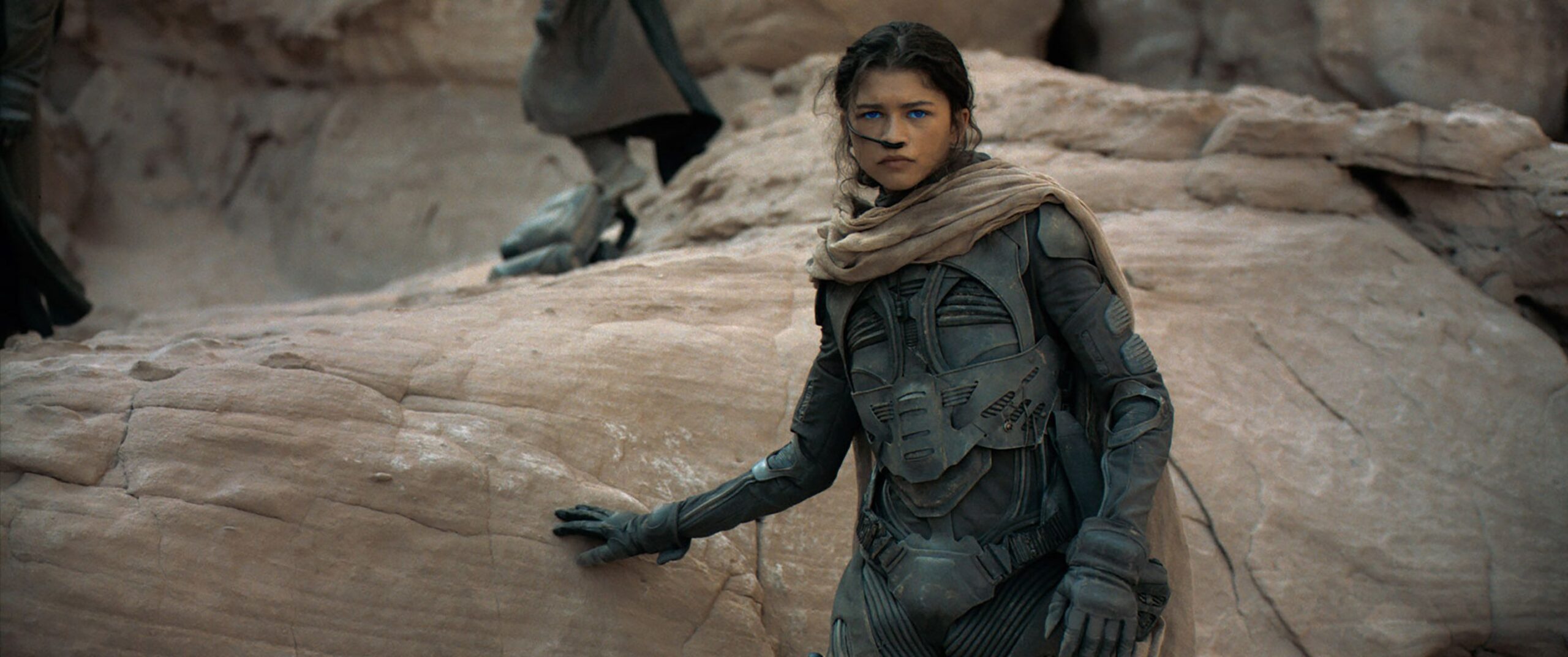
These pictures were always about sanding down the less palatable aspects of non-white identity. In Zendaya’s roles, like “Dune,” her Blackness and her star-ness are tethered to a definition of movie stardom that ultimately defines itself through whiteness and casts people who look like her as the other.
When I watch Zendaya, my worst fear is that she’ll become her generation’s Morgan Freeman—someone who spent the majority of his career being that great neoliberal construction of pop “universality,” which of course means appealing to whiteness. An actor we’ve never been afforded the ability to see surrounded by Blackness, seen through, and made for our eyes. I fear seeing a talented actor like Zendaya left unrealized, as a bifurcated identity reduced to its status quo mono.
Every non-white actor worth their salt would love the freedom of their white counterparts, to have the privilege of being able to be in any number of unique stories, personalities, or bodies, to not be so reduced by their own body as to deny the existence of their body to gain that freedom. Think about James Baldwin writing about Poitier’s role in “In the Heat of the Night” in The Devil Finds Work: he says, “it gave me the impression, according to my notes the day I saw it, of something strangling alive, struggling to get out.” Seventy years later, I could say the same about Zendaya’s Blackness in any of her roles.
While I admire the intentionality behind Zendaya’s choice not to take away roles from dark-skinned Black women, I question the efficacy of a strategy that trades one form of reduction for another. After all, in the great boom of the Black ‘90s, did the presence of Halle Berry deny the presence of Angela Bassett or Nia Long? Theresa Randle, AJ Johnson, Vivica A. Fox, or Regina King?
Discourses that develop around this subject tend to devolve into conversations around the individual when the systems at play are as in question now as they were then. Whatever the Black or biracial movie star is going to be in the future, that racial context cannot be ignored for the sake of access to that level of stardom, especially when that level of stardom should be in question itself. We cannot trade the work for half, or even all, of one’s identity. We should center those questions around what can be added, not subtracted.

